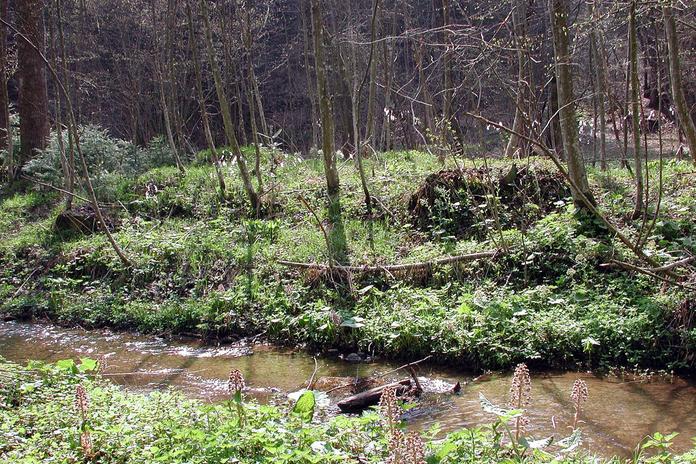
 Photo: Josef Weinzettl
Naturlehrpfad Willersdorfer Schlucht - Aschauer Au
Oberschützen, Burgenland
The area of the Willersdorfer Schlucht begins in Willersdorf, a district of Oberschützen, and extends northwards to the Dreiländereck, the border between the federal states of Lower Austria, Styria, and Burgenland, about 6 km away. Approximately halfway, a side valley branches off to Aschau, also a district of Oberschützen. The Bernsteiner Gebirge directly adjoins the northeastern flank. Coming from Lower Austria, the Willersbach flows through the entire length of the area, maintaining its originality until Oberschützen. Climatically, the entire area is influenced by the Wechsel. The Willersdorfer Schlucht - Aschauer Au represents a special feature in biological and geological-geographical terms. As an offshoot of the Wechsel massif, the area is part of the Central Alps of Austria, which is also manifested by the occurrence of montane and alpine flora and fauna elements. A large part of the area is covered with forest, with the flanks in particular being characterized by mixed forest consisting of hornbeams, ashes, and sycamore maples. At higher altitudes, red beech, occasionally also mountain elm, and even green alder can be observed. In autumn, these mixed forest stands are of outstanding scenic beauty. The vegetation of typical gorge forests with very beautiful alder stands at the bottom of the valley indicates high humidity and good water supply. The valley floor is particularly interesting with its differently developed valley meadows (wet, damp, and also lean meadow areas), which offer important habitats for a great variety of plants and animals. These always extensively maintained meadows have been increasingly reforested or fallen fallow, especially after several flood events, which sustainably impaired the landscape. Numerous efforts have been made in recent years and decades to secure this jewel with its high biodiversity in the long term, unfortunately without success so far. However, within the framework of an ÖPUL program (Austrian Program for the Development of Rural Areas) under the coordination of the Austrian Nature Conservation Association, a meadow restoration project was started and implemented in 2004. In 2006, a nature experience trail with eight stations covering different thematic areas related to the existing landscape was established. From a cultural-historical perspective, the Willersdorfer Schlucht - Aschauer Au also holds some special features. The once continuous valley meadow landscape was an important mill region in historical times, of which today there are only a few witnesses. The Valtl-Mühle is privately owned and now serves as a residential house. The Patrizl-Mühle only exists as a ruin, and then there is the Kirnbauer-Mühle at the end of the valley floor before the village of Loipersdorf. Directly at the valley entrance on a left-hand flank called Schlossleiten, a small castle complex once stood, which also only exists as modest remains. It was probably built in the 12th and 13th centuries as a pre- and main castle. The castle complex probably existed until the 16th century, after which it was abandoned and visibly decayed. Several stories are associated with the castle, the most famous being the story of the "Schlosshansl", who as a notorious robber primarily ambushed passing traders and merchants. (Text: Josef Weinzettl)
Map & directions
Events nearby
Upcoming events within 10 km.



Experiences
Tours & activities in Burgenland
Guided tours, tickets and experiences in Burgenland — bookable via GetYourGuide.