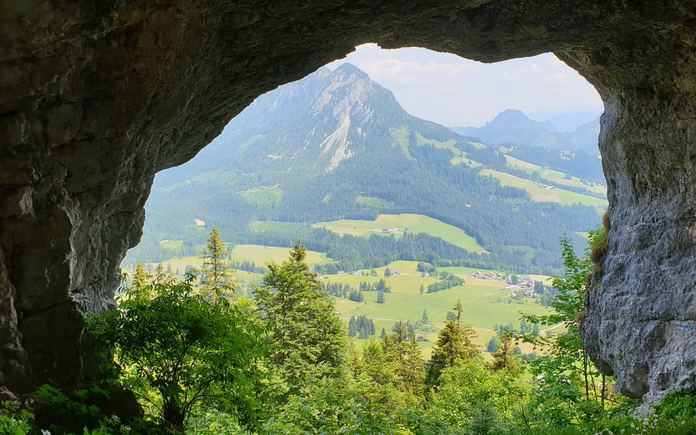
 Photo: Daniela Casari
Lieglloch
Tauplitz, Styria
Otherwise, the portal, which is up to 15 meters wide and 10 meters high, only opens up before you at an altitude of 1,290 meters above sea level, once you are directly in front of it. You reach the Lieglloch via the district of Hollam, above Tauplitz. Walking time approximately 45 minutes.Due to its good accessibility and visibility, humans were in the cave very early on, possibly hunting cave bears. Numerous excavations since 1926 have brought valuable finds to light (two fire pits, stone tools, bone needle, a bone flute with two holes, medieval double-headed pendant, etc.). Other cave contents were collected and used by farmers as fertilizer in the interwar period.Only the first part of the cave is easily accessible. A horizontal passage can be followed for about 50 meters, sometimes upright, sometimes bent.The Liegl LegendIn Hochlamb above Tauplitz once stood the farm of the farmer Liegl; and because a large cave extends far into the mountain behind the Liegl farm at the foot of the Bergerwand, this cave was called “Lieglloch.”Once upon a time, three Wildfräulein (wild maidens) lived in the Lieglloch, who were very good-natured. They always got milk from the Liegl farmer, for which they let the necessary water flow from a spring in their cave for him, his people, and his cattle. Furthermore, they made everything on the Liegl farmer's meadows and fields thrive, so that the farmer soon became rich and gained great respect in Tauplitz.This went well for centuries. But after many generations, a Liegl farmer suddenly became so arrogant that he believed he no longer needed the Wildfräulein. When one of the Wildfräulein came to get milk that evening, the farmer refused her. When the Wildfräulein offered him her silver belt for milk, he said that it was just enough for a single time. The Wildfräulein became very angry. But as the farmer could not be swayed, she promised to leave him the belt for this one time. However, so that the Wildfräulein could continue to get milk, she offered him a choice between two options: If he returned the Wildfräulein's silver belt, he could receive everlasting fertility for his meadows and fields; otherwise, he could wish for money, for which he would have to tie the belt around the tree in front of the house and speak his wish. The Liegl farmer decided to keep the belt and make money with it. No sooner had the Wildfräulein left than he rushed with the belt to the tree, tied it around the tree trunk, and shouted that he wanted a drawer full of gold money. No sooner was this wish spoken than a bright lightning bolt, with a mighty clap of thunder, struck the tree with the Wildfräulein's belt and completely tore it apart. Nothing happened to the farmer, but he was seized with great fear and ran into the house, locked the front door, and trembled like an aspen leaf. When some lads passed by the Liegl farmer's house after midnight, they still saw light in the parlor, and when one of them curiously peeked through the window, he recoiled in horror. A headless man sat at the table, counting a large amount of gold coins.The Wildfräulein have disappeared since that day. The Lieglloch still exists today. What became of the headless Liegl farmer is unknown. However, the later Liegl farmers had great difficulty maintaining the farm. The harvests became smaller and smaller, the water inflow sparser. For more than a hundred years, the former Liegl estate has been only a Lehen (Pfannerlehen - feudal tenure).Source: Sagenhaftes Hinterbergertal, Sagen und Legenden aus Bad Mitterndorf, Pichl-Kainisch und Tauplitz vom Ende der Eiszeit bis zum Eisenbahnbau, Matthias Neitsch. Developed as part of the Leader+ project “KultiNat” 2005 – 2007.© Matthias Neitsch
Opening hours & season
- 01.05.2027 – 31.10.2027dailyopen all day
Map & directions
Events nearby
Upcoming events within 10 km.
Experiences
Tours & activities in Steiermark
Guided tours, tickets and experiences in Steiermark — bookable via GetYourGuide.