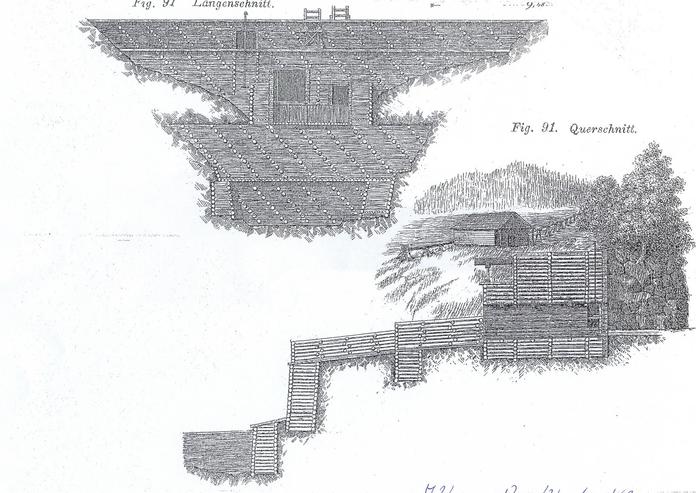
 Photo: Quelle: Archiv Eduard Sulzbacher
Hinterberger Panoramaweg - Station Lenzbauernalm
Bad Mitterndorf, Styria
Historical Saltworks - Timber Rafting Until the railway era, the forests of the Hinterbergertal supplied "Hallholz" (timber for salt production) for the Aussee saltworks. The tributaries of the Traun, the Ödensee, and other waters were, as everywhere in the Salzkammergut, connected to an overarching "rafting system," based on a variety of technical facilities (Risen, Klausen, and Rechen). A significant part of the wood came from the Kemetgebirge, located on the southern edge of the valley, in front of the eastern Dachstein plateau. Saltworks laborers rafted Hallholz from the Ridlbach and the Ödensee further to the Kainischer Traun to Aussee. An example of a technical facility is the Ridlbachklause (rafting dam), first documented in 1561 and rebuilt in 1868 from ashlar stones, located above Mühlreith and still visible today. In 1901, the rafting of Hallholz in the Salzkammergut was discontinued. Historical Saltworks - Peat Extraction in the Ödensee Moor From the 18th century onwards, the Aussee saltworks used peat as a substitute and supplementary material for firewood in the brine boiling process. Peat cutting at the Ödensee began in 1741. During the 19th century, peat production at the Ödensee continuously increased. Peat cutting was always seasonal piecework in summer. Each late autumn, peat was brought to Unterkainisch (saltworks location) and, mixed with wood, used for the brine boiling operation. Peat extraction in the Ödensee Moor initially survived the introduction of coal. Its final cessation occurred in 1925. Historical Saltworks and Local Craft Businesses Since the Middle Ages, the Hinterbergertal was part of the saltworks region and subsequently part of the Styrian "Kammergut" (chamber estate) of the sovereign and later the state. The historical Aussee saltworks were associated not only with timber use but also with a number of other trades in the valley. These included, for example, salt transport, craft businesses such as wagon makers, blacksmiths, saddlers, or sawmills, and a brickworks southwest of the Kumitzberg. Numerous inns and guesthouses existed along the salt road. One of the largest private workshops in the valley was the tool forge of the Kalß family in Mühlreith. The business was later taken over by Johann Weihnacht, who achieved prosperity with special products such as draw knives, scythes, and sickles, which were exported as far as Russia. Paul Adler, the Hinterberg Agricultural Pioneer About 200 years ago, the farmer Paul Adler (1770 – 1843) from Mühlreith played a special role in agricultural progress in the Hinterbergertal. He was in close contact with Archduke Johann, who supported agricultural modernization in Styria and had founded the Agricultural Society (predecessor organization of the Chamber of Agriculture) in 1819. Adler knew the important agricultural textbooks of his time. He experimented in various areas, gained experience, and made records – for example, in potato, grain, and fruit cultivation, in beekeeping, and in wool processing. Adler was also active in weather observation and possessed all the important utensils of a natural scientist of his time. He is credited with several innovations in the valley, such as the introduction of potatoes and the Pinzgauer cattle breed. As a sideline, Adler worked for many years for the Aussee saltworks as a master journeyman in wood and stone work. He was a child of the Josephine era and saw himself as a persistent social-liberal reformer. He sought interaction with educated people, sought intellectual freedom, cared little about social distinctions, and advocated for the concerns of the neighborhood and the poorer population. Kainisch - Pichl – Mühlreith - Knoppen The villages of Knoppen, Pichl, Mühlreith, and Kainisch were part of the "Herrschaft Hinterberg" (Lordship of Hinterberg), which existed from the Middle Ages until 1848. Together, they eventually formed the political municipality of Pichl or Pichl-Kainisch, which merged with the municipality of Bad Mitterndorf in 2015. While timber industry, craft businesses, peat extraction, and mountain farming were once dominant, Pichl and Kainisch now host the Ödensee nature experience and are an important commercial location. Moors in the Ödensee Nature and European Protected Area Even in the 1950s, extensively managed litter meadows and fens with the remaining raised bog remnants characterized the small-scale landscape of the Ödensee basin as well as other parts of the Hinterberger Tal (Rödschitzer Moor, Krungler Moor). After over one hundred and fifty years of peat extraction, three raised bog remnants have survived from the once extensive raised bog landscape: the Kainischmoor-West and Kainischmoor-Ost, as well as the Ödenseemoor. Only a few remnants of still living raised bogs remain from the once extensive moor landscape of the Ödensee basin. For a good 180 years, from 1742 to 1926, peat was extracted in this area. The peat cut at that time was used for salt production in the Aussee saltworks, with the extraction depth reaching up to four meters. This also explains the abrupt differences in height (up to over two meters) between intact raised bog areas and underlying areas (often degraded bogs or bog forests). The moor with the largest extent and best state of preservation is the Kainischmoor-West. The two remaining, significantly smaller moor areas are affected to varying degrees in their naturalness by unfavorable edge effects and drainage measures. All three mentioned moors still show typical bog biotope structures such as hummocks and hollows in their interior. The most important characteristic species of ombrotrophic raised bogs such as bog rosemary (Andromeda polifolia), sundew (Drosera spp.), white beak-sedge (Rhynchospora alba), hare's-tail cottongrass (Eriophorum vaginatum), and cranberry (Vaccinium oxycoccus) are also present. The strong spread of mountain pines (Pi
Opening hours & season
- 01.05.2026 – 31.10.2026dailyopen all day
- 01.05.2027 – 31.10.2027dailyopen all day
Map & directions
Events nearby
Upcoming events within 10 km.
Experiences
Tours & activities in Steiermark
Guided tours, tickets and experiences in Steiermark — bookable via GetYourGuide.