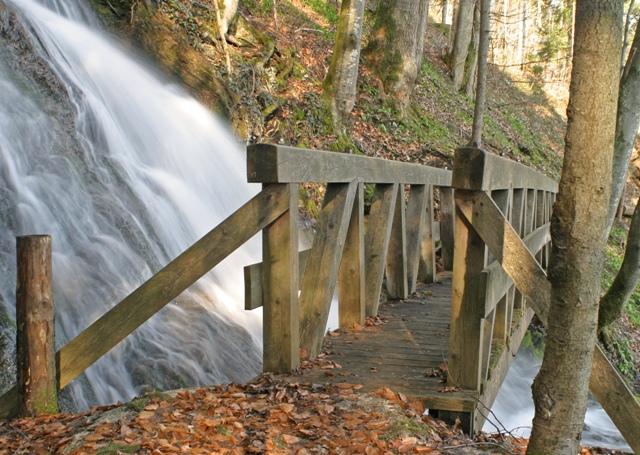
Wasserfall und Informationen zur Ruine Wartenfels
Hof bei Salzburg, Salzburg
The two arms of the waterfall are very impressive, especially after rainfall. If you visit at such a time, let the energy and power affect you by standing in the middle of a bridge, as it feels like you are standing in the middle of the roaring fall. Stepping out of the forest, a magnificent landscape unfolds before us: green hillside meadows, forests, and beautiful farmhouses. In the background, the Schober comes into view, and at its foot, the Wartenfels ruin (belonging to Thalgau). The former Wartenfels Castle was built around 1260. As its name suggests, it served as a border fortress. (Salzburg only became part of Austria in 1816; before that, our country was separated from Upper Austria by a state border!) Until approximately 1600, Wartenfels was the seat of the Pfleger (Haas, p. 34), a high official appointed by the archbishop, who was responsible as both judge and chief administrator, military and police commander for the entire judicial district. Probably at the beginning of the 17th century, the Pfleger moved to Thalgau, and from then on, the castle fell into disrepair. Before 1848, there were no local municipalities; the judicial district was divided into individual "Rügate" (from rügen = to judge, to order). The Wartenfels administrative court included twelve Rügate: Elsenwang (most of our current municipality of Hof), Schroffenau, Thalgau-Dorf, Vetterbach, Thalgauberg, Enzersberg, Fischerweng, Thalgauegg, Fuschl, Faistenau, Tiefbrunnau, and Hintersee.
Map & directions
Anzeige
Events nearby
Upcoming events within 10 km.


Experiences
Tours & activities in Salzburg
Guided tours, tickets and experiences in Salzburg — bookable via GetYourGuide.