Wallfahrtskirche "Maria, Mutter vom Guten Rat"
Bad Gastein, Salzburg
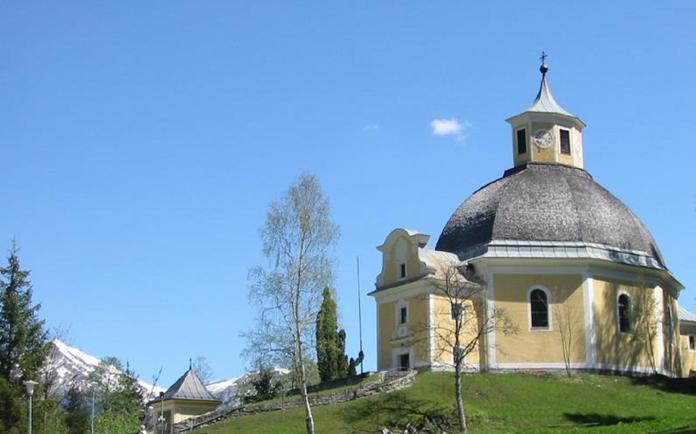
At the southern end of the valley, on a picturesque hill in the Knappensiedlung Altböckstein, lies the parish and pilgrimage church "Maria, Mutter vom Guten Rat". The construction of a church was initiated when the miners requested their own place of worship and a chaplain from Archbishop Sigismund Christoph Graf von Schrattenbach (reigned 1753-1771). The prince-archbishop himself purchased the necessary land and provided sustainable financial support for the church's construction. The foundation stone was laid in 1764. By 1765, the building was already vaulted, covered with a roof, and painted inside. The interior furnishings were completed by Pentecost 1766. On July 26, 1767, the church was solemnly consecrated by the prince-archbishop in honor of Mary, the Mother of Good Counsel. Schrattenbach also sent various valuable furnishings (chalice, vestments, monstrance) in the years following the church's consecration. The building: The plans for the picturesque church were drawn up by Wolfgang Hagenauer, the high prince's building supervisor. The construction was carried out by master mason Christian Glaner from Werfen. From the outside, the church appears as a long, octagonal structure, but inside, it is designed oval. Above the dome-shaped roof is a clock and bell tower with a spire. To the east is the two-story sacristy, and to the west, the porch, on which the stucco coat of arms of the prince-archbishop is mounted. The interior of the church is divided into eight niches with large windows. The diagonally positioned niches are equipped with galleries. The rear niche in the west is open to the organ gallery. The wall sections between are framed by flat pilasters with simple leaf stucco in the capital area. The frescoes: The impressive fresco in the church's dome was created by Augsburg painter Johann Weiß and depicts the legend of the miraculous image from Genazzano. Angels carry the painting into the church from Genazzano, accompanied by dancing putti. Pilgrims, cripples, the lame, and others in need of help sit or stand on the steps to the sanctuary. On the right side of the fresco, a mountain with tunnels and miners with raised and clasped hands are depicted. Weiß also painted an oriental landscape with pyramids, domed buildings, and obelisks as a reference to the original origin of the miraculous image. The western section shows an old and a young pilgrim in a peculiar intertwining before a seascape. The high altar: The high altar was created in 1765/66 by Johann Baptist Hagenauer, the brother of the architect. The side vases contain a fire column and a cloud column, referring to the signs of God's presence during the exodus of the people of Israel from Egypt (Ex 13:21). According to legend, the fire and cloud columns were visible during the transfer of the miraculous image over the sea. On the sarcophagus-like mensa is the simple, tempietto-shaped tabernacle. Originally, four late Baroque statues of the four Latin Church Fathers were also placed on it. In the central round-arched niche of the white-golden altarpiece, two large neoclassical angels hold the oval miraculous image painted by Rosa Hagenauer, surrounded by a halo of rays. The framing pilasters support a straight entablature. Above, between the crossed braces, surrounded by clouds and cherub heads, the name of Mary is illuminated in gold in a sun. The pulpit: Also by Johann Baptist Hagenauer, the semicircular pulpit features a basket, back wall, door, and sounding cover divided by pilasters, rows of leaves, and floral festoons. The medallions of the basket depict the three divine virtues—faith, hope, and love—with their symbols. The Holy Spirit dove in the mirror of the sounding cover indicates the divine origin of the Word of God. The four evangelist symbols (angel—Matthew; lion—Mark; ox—Luke; eagle—John) are found on the edge of the cornice. The globe, depicted on the sounding cover, is dominated by the Ten Commandments. Side altars: In 1776, the side altars were supplied by Leopold Hacksteiner, a carpenter from Rauris. Since they did not match the overall appearance, they were likely heavily modified in the 19th century and adapted to the neobaroque interior. The simple paintings were created by an artist of unknown name and depict legendary episodes from the life of Mary (left: Mary’s presentation as a temple in Jerusalem; right: her marriage to Joseph). Figures and paintings: The high-quality Stations of the Cross from the last quarter of the 18th century, the large crucifix by Kaspar Bichler (1850), two small paintings of the mining patrons Barbara and Nikolaus by Sebastian Stief (1882), and the organ with its neobaroque casing by Matthäus Mauracher (1895), as well as the baptismal font made of Untersberger marble installed in 2007, fit harmoniously into the church interior. The church can only be entered during mass. Holy mass is held every Sunday at 10:00 a.m. An individual visit is not possible. For inquiries about guided tours, please contact: pfarre.badgastein@pfarre.kirchen.net.
Opening hours & season
- 03.05.2026 – 31.12.2030So10:00–12:00
Map & directions
Events nearby
Upcoming events within 10 km.

Experiences
Tours & activities in Salzburg
Guided tours, tickets and experiences in Salzburg — bookable via GetYourGuide.