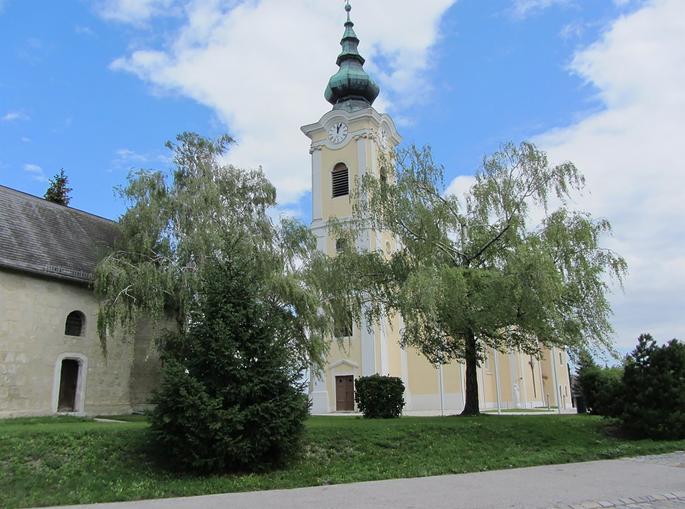
 Photo: Diozöse Zemendorf
Wallfahrtskirche Kleinfrauenhaid
Zemendorf-Stöttera, Burgenland
The pilgrimage church Mariä Himmelfahrt, Kleinfrauenhaid in Zemendorf belongs to the Mattersburg deanery in the Diocese of Eisenstadt. The church is a protected monument. The presumably older parish is first mentioned in a document in 1261 and was incorporated into Lambach Abbey from 1692 to 1781. The mighty late Baroque church building with a west tower was rebuilt in 1662 and severely damaged during the Second Siege of Vienna in 1683. Reconstruction began in 1693. The tower was erected in 1778 and the church was consecrated in 1785. Architecture: The nave with buttresses was built around 1700 and the orientation is a floor plan in the shape of a Greek cross with a semicircular apse. On the gable facade stands the richly structured three-story church tower with pilaster articulation on the upper floor, segmental gables, and an onion dome. The west portal in the tower hall bears the year 1766. South of the nave, the Franz-Xaver-Kapelle was added in 1694, and to the north, in the second half of the 19th century, a mausoleum of the Rothermann family with terracotta ornamentation. The two-bay nave under a barrel vault has a gallery over a groin vault. In the middle of the nave are transept-like extensions under a domical vault. The domical vaulted choir with a round apse has a sacristy on the left and a confession chapel on the right. Furnishings: The high altar has a late Baroque freestanding tabernacle, which is modeled after a round temple with a dome. On the apse wall, under a rich baldachin, is a miraculous image of the Black Madonna, after a Byzantine icon, marked with the year 1460, where it is presumed that the miraculous image is by the painter Unger from Wiener Neustadt. The miraculous image was transferred here from Forchtenstein by Prince Paul Esterházy in 1694. The original acanthus frame of the miraculous image was replaced by a silver frame, which was donated in 1736. The side altars bear modern figures. The left side altar bears an oil painting St. Anne teaching Mary to read by Stephan Dorfmeister from 1784. The oil paintings in the nave St. John of Nepomuk on his deathbed, St. Francis Xavier, Holy Family are also attributed to Dorfmeister. There is a Baroque stone communion rail. A silver eternal light lamp is noteworthy. The organ dates from 1856.
Map & directions
Anzeige
Events nearby
Upcoming events within 10 km.


Experiences
Tours & activities in Burgenland
Guided tours, tickets and experiences in Burgenland — bookable via GetYourGuide.