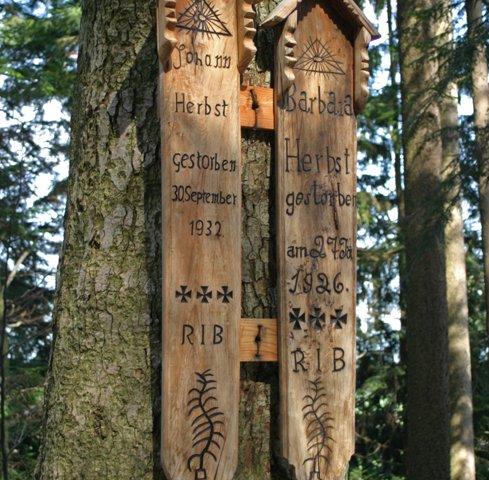
Totenbretter
Hof bei Salzburg, Salzburg
They commemorate deceased members of the Laistbichlgut farming family. What do these Totenbretter (death boards) mean? Today, they are a custom, but in the past – 200 years ago and further back – they were a necessity at funerals. Since coffins were too expensive at the time, the deceased was wrapped in cloths and the body was tied with cords to a suitable board. At the funeral, the board was tilted over the grave, the gravedigger cut the cords with a knife, and the body slid – feet first – into the grave. (Even today, the idiom "vom Brettl rutschen" (to slide off the board) recalls this custom.) After the funeral, the name, as well as the birth and death year, were carved into the board, it was decorated with symbolic representations (tree of life, cross, skeletal remains, sun, moon, stars), and finally hung in suitable places (chapels, hay barns, trees, crossroads). Today, Totenbretter (also called Leichenladen in some places), similar to Marterl (wayside shrines), serve only as a memorial. Here, they are found exclusively in formerly Bavarian settlement areas: in Flachgau, in the Tennengau Salzach Valley, and in Mitterpinzgau. They are rare in Pongau and unknown in Lungau.
Opening hours & season
- 25.07.2025 – 25.07.2040daily06:00–22:00
Map & directions
Events nearby
Upcoming events within 10 km.


Experiences
Tours & activities in Salzburg
Guided tours, tickets and experiences in Salzburg — bookable via GetYourGuide.