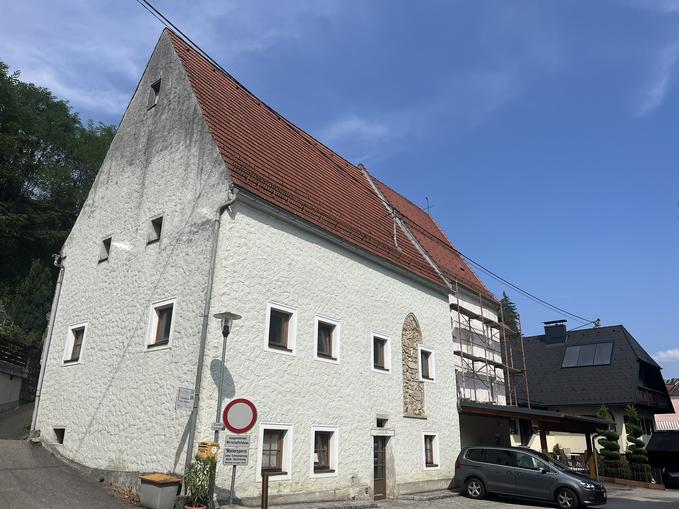
 Photo: Christina-Ahorner-Reumann
Strudener Schifferkirche
St. Nikola, Upper Austria
The legend reports that Emperor Maximilian I, when he stayed overnight at his castle in Werfenstein in 1502, only escaped certain death from a ceiling collapse because the grey dwarf warned him in time and thus saved him from death.As a document from the former Free Court of Struden dated November 16, 1790, testifies, Emperor Maximilian was indeed the founder of the Marienkirche in Struden. He wanted to give the boatmen and salt carriers traveling up and down the opportunity to attend a holy mass here on Sundays and holidays.In 1784, by order of Emperor Joseph II, this church was closed and sold in favor of the religious fund. The buyer built apartments there. Since the final auction in 1792, the building, converted for residential purposes, has been in private ownership.The high altar with the tabernacle went to the parish church of St. Nikola, as did the statue of Mary, the vestments, chalices, candlesticks, and church linens, while the small organ went to the church in Klam; the two bells were taken to Kreuzen. This old Gothic boatmen's church can still be recognized today by its polygonal apse in the turret and its bricked-up pointed arch windows. In front of the former church is a small square where the symbol of market justice and the free court, the pillory, once stood, which is now wrongly located at Werfenstein Castle.
Map & directions
Events nearby
Upcoming events within 10 km.
Experiences
Tours & activities in Oberösterreich
Guided tours, tickets and experiences in Oberösterreich — bookable via GetYourGuide.