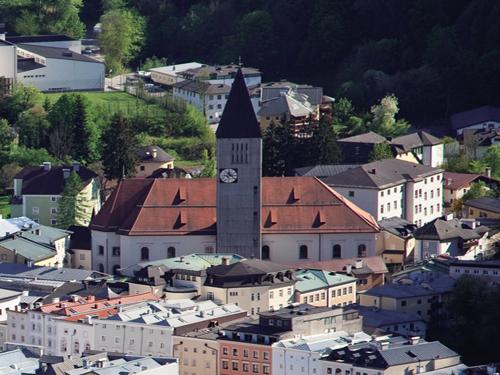
 Photo: TVB Hallein
Stadtpfarrkirche Hallein
Hallein/Bad Dürrnberg, Salzburg
The Stadtpfarrkirche Hallein was first mentioned in 1206. In 1775, after renovations, it was rededicated as a neoclassical hall church. Unfortunately, the church was destroyed by fire in 1945. The magnificent Romanesque bell tower was replaced in 1965 by a modern structure. However, old marble grave plaques can still be seen on the exterior walls of the church. Walking around the Stadtpfarrkirche along Augustinergasse uphill, you first pass the parish house, then the small but noteworthy Peterskapelle (St. Peter's Chapel). On the outer wall of the church, old marble gravestones are still visible. Returning to the church square on the mountain side, you will find the residence and death house of Franz Xaver Gruber, the composer of "Stille Nacht, Heilige Nacht" (Silent Night, Holy Night), who worked here in Hallein as a choir director and organist. During the renovation of the Stadtpfarrkirche Hallein in 2005, archaeologists possibly discovered the country's first documented plague cemetery. This is a mass grave from the 16th century, in which numerous children are also buried. Archaeologists believe it was a plague cemetery where victims of the 1597 plague epidemic were laid to rest. About 200 skeletons were excavated. The respect that the former inhabitants of Hallein had for their ancestors is shown by the fact that the new church built in the 18th century over the old Gothic one did not disturb the graves of the plague victims. Service on Sunday at 09:00 a.m.
Map & directions
Events nearby
Upcoming events within 10 km.


Experiences
Tours & activities in Salzburg
Guided tours, tickets and experiences in Salzburg — bookable via GetYourGuide.