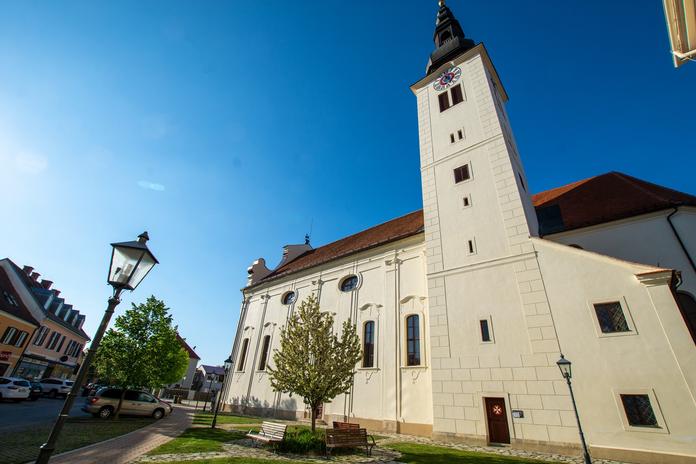
 Photo: Pfarrverband Fürstenfeld · Christian Thomaser
Stadtpfarrkirche Fürstenfeld
Fürstenfeld, Styria
Parish Church of St. John the Baptist The church was founded around 1200 by the Knights Hospitaller. During the Hajduk invasion in 1605, the church was severely devastated and plundered; the pews and altars were destroyed. From 1772 to 1778, it was rebuilt into its current form under the direction of master builder Leopold Ainspinner. Of the two towers present at the time, the one on the west side was removed. In 1945, shelling by German artillery caused severe damage. Work on repairing the damage continued until 1947. In 1988, the onion dome was rebuilt after a private initiative secured the financing. The redesign of the altar area (1995) is by Gottfried Johannes Höfler. In 2003, two of the formerly 20 stained-glass windows from the Mission Church of St. Severin, which had been closed in 1985, were installed in the church: "The Creation of Nature" by Hans Wolf from 1965 and "The Creation of Man" by Erika Wolf-Rubenzer from 1964. MALTESE ORDER COMMANDERY In its current form, the Fürstenfeld Commandery is the oldest settlement of the Knights Hospitaller in Austria. It was founded around 1200 as a hospice. In 1605, it was devastated and burned down by the Hajduks. In 1664 (Battle of Mogersdorf), Raimund Graf Montecuccoli moved his headquarters here. In 1945, the Commandery was severely damaged and not rebuilt to its original size. PARISH RECTORY It was built in 1723 under Commander Poppo Graf Dietrichstein and city parish priest Dr. Kaspar Walter Soecker. In 1945, the building was severely damaged. In 1993, a fundamental renovation and modernization of the rectory took place. The Latin inscription above the entrance of the rectory translates into German as: "After Charles VI's coronation as king in Prague and while Elisabeth there, by God's grace, awaited her confinement, this building was erected from the ground up under the kind and gracious patronage of Gundakar Poppo Dietrichstein and with the benevolent support of Kaspar Walter Soeker, parish priest and doctor of sacred theology." The inscription contains a "chronogram" typical of the Baroque period, meaning the letters in red in the inscription yield the year 1723.
Opening hours & season
- 25.01.2022 – 25.01.2025dailyopen all day
Map & directions
Events nearby
Upcoming events within 10 km.


Experiences
Tours & activities in Steiermark
Guided tours, tickets and experiences in Steiermark — bookable via GetYourGuide.