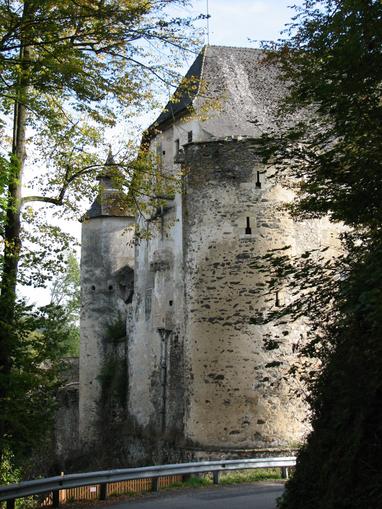
Schloss Marsbach
Hofkirchen, Upper Austria
The castle is situated on a narrow ridge that slopes steeply down to the Danube and has the character of a fortress. The location is so favorably chosen that the Danube can be overlooked and controlled from Niederranna to the Schlögener Donauschlinge. This played a major role in monitoring Danube traffic and later for the robber knights.Marsbach was first mentioned in a document in 1075 as "Morspah", making it the oldest noble seat in the upper Mühlviertel. The castle is situated on a narrow ridge that slopes steeply down to the Danube and has the character of a fortress. The location is so favorably chosen that the Danube can be overlooked and controlled from Niederranna to the Schlögener Donauschlinge. This played a major role in monitoring Danube traffic and later for the robber knights.Marsbach was once the seat of a quarrelsome and predatory lineage. Wernhard von Morspach, mentioned in 1187, belonged to this lineage. The Marsbachers appear primarily in Passau documents in the first years of the 13th century; Otto is mentioned as a Passau ministerialis in 1226.Marsbach Castle, castrum marspach, was one of those fortresses from which the Bishop of Passau suffered such damage that King Heinrich VI. was prompted to take action against them with a declaration of outlawry in 1222. Heinrich von Marsbach was forced to surrender the castrum marpsach to the Bishop of Passau as compensation for the damage inflicted on the diocese. A repetition of the subjugation occurred in 1255 by Otto von Marsbach. He wanted to take possession of Marbach Castle before his father Ortolf's death, attacked the castle, and drove out his father, who had to seek protection in Passau. An arbitration award by Duke Heinrich of Bavaria, to whom Otto had submitted, ended the dispute between father and son in 1268. Otto himself, however, did not give up his claims and seized the castle in 1269, from which he, as a robber knight, made the Danube and the roads between Passau and Eferding unsafe in league with Pilgrim von Falkenstein and Chunrad von Tannberg. In 1529, the administration of the Passau possessions in Mühllande (Mühlviertel) was moved to Marsbach. The regional court, which had previously existed in Neufelden, also came to Marsbach. After the secularization of the Diocese of Passau, Marsbach came under Austrian administration, became a Kammergut (chamber estate) in 1805, and was publicly auctioned in 1824.Stories about MarsbachThe Mortsbachers harmed their liege lord, the Bishop of Passau, wherever they could. In 1222, they plundered Passau property so thoroughly that the imperial ban was imposed on them. Bishop Gebhard could not defend himself against them. His successor, Bishop Rüdiger, however, marched with an army to the castle and forced Heinrich von Marsbach to surrender it to him until he had compensated for the damage he had caused. But nothing changed thereafter, except that the scheming, quarrelsome, and feuding lords in the bold castle above the Danube also fell out among themselves. Otto, whose father Ortolf lived too long for him, one day attacked the castle with the Tannbergers and drove out the old man, who had to seek protection in Passau. According to the arbitration award, the wayward son was to leave the fortress with his father for a settlement sum and only get it back after his death. But the father did not pay. Instead, he sold the castle to the Passauers so that nothing would fall to the rabid fellow even after his death. When the neighboring Falkensteiners and Tannbergers also interfered in this affair, which was by no means unusual at the time, a feud of all against all was due. Rudolf von Habsburg, without hesitation, confiscated Marsbach for the empire due to a breach of the peace and handed the property over to his son Albrecht. But the Passauers forced the Duke to surrender Marsbach to them. The Marsbachers had long been extinct when an Othmar Oberheimer, = the last feuding knight =, established himself in the masonry of the old castle. Only after his execution did Marsbach again belong to the Passauers, who set up an administrative center in the castle. Between 1561 and 1598, Bishop Urban had the already dilapidated complex rebuilt in the Renaissance style. After 1803, it became an imperial Kammergut, auctioned in 1824, Marsbach quickly changed owners. In 1957, the castle was converted into a castle hotel. The hotel went bankrupt, and so the castle stood empty for several years until it was acquired by the current owner, Mr. Georg Stradiot.Marsbach Castle is located next to the road from Marsbach to Freizell.
Map & directions
Events nearby
Upcoming events within 10 km.

Experiences
Tours & activities in Oberösterreich
Guided tours, tickets and experiences in Oberösterreich — bookable via GetYourGuide.