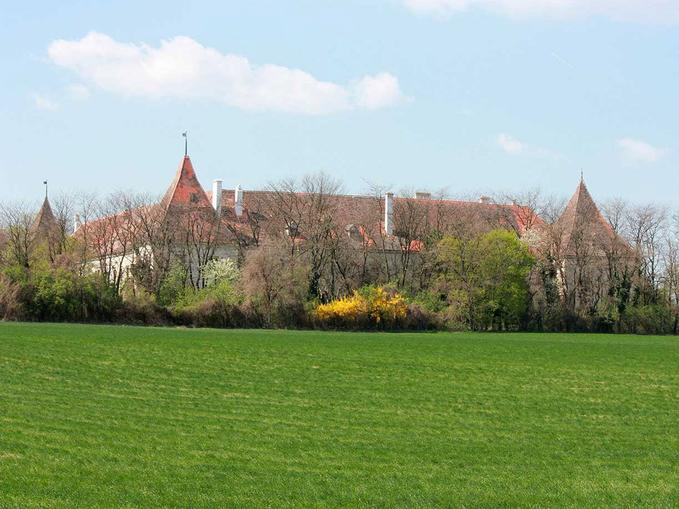
Schloss Deutschkreutz
Deutschkreutz, Burgenland
Schloss Deutschkreutz in central Burgenland was built in 1625 by Count Paul Nádasdy in the style of the Italian Renaissance. The four-winged, two-story complex with a rectangular arcaded courtyard and four corner towers is a typical example of the combination of manor house, castle, and farmstead in the borderland. Despite the geographical distance from the Italian Renaissance, the castle impresses with its clear proportions and stylistic purity. It was once a cultural center with its own printing press and theater operations. After the death of Count Franz Nádasdy in 1671, the castle lost its importance, was used as a farmstead, and was severely damaged by Soviet troops in World War II. In 1966, the Austrian artist Anton Lehmden acquired the castle in a desolate state. He dedicated himself to its extensive restoration until his death in 2018, making the castle his center of life and work. He established the Lehmden Museum on over 800 m², offering a comprehensive insight into his artistic work. Particularly noteworthy is the castle chapel, which was established in 1643 after Franz Nádasdy's conversion to Catholicism and is now equipped with glass paintings by Lehmden. Since 1971, the castle has been a protected monument as a "cultural property in the sense of the Hague Convention." Today, Schloss Deutschkreutz serves not only as a museum but also as a cultural center and event venue, operated, among others, by the association "Kultursignale Schloss Deutschkreutz." Guided tours and events make the historic complex accessible to a wide audience.
Map & directions
Events nearby
Upcoming events within 10 km.



Experiences
Tours & activities in Burgenland
Guided tours, tickets and experiences in Burgenland — bookable via GetYourGuide.