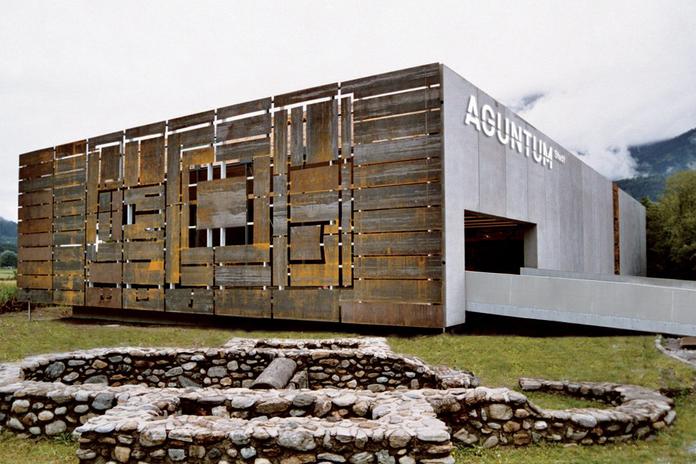
Römerstadt Aguntum
Dölsach, Tyrol
If entire armies of archaeologists have been coming to Aguntum for many decades, it's not without reason. It's probably because not everything has been excavated in Aguntum yet, and there's still much to discover. Among other things, the highly interesting past of today's municipality of Dölsach. Since 1991, the excavations in Aguntum have been in the hands of the Institute for Archaeologies at the University of Innsbruck. Currently, the forum of Aguntum is being uncovered. Gradually, one of the most impressive Roman cities in the mountains is being revealed. And what has been uncovered so far is truly remarkable. Especially since the Aguntum Museum decided in 1999 to erect a protective structure over the entire atrium house. The construction of this "protective structure" alone is worth seeing; its architecture is visible from afar when approaching the museum on the federal highway. The museum offers insights into daily life during Roman times and displays various finds from Aguntum, as well as other areas of the former province of Noricum. The building sparks curiosity and raises questions. The answer to the question "should I stop and look at all this" should be a loud and clear "Yes". It's worth it. Aguntum was a Roman city (Municipium Claudium Aguntum), located approximately 4 km east of Lienz in the current municipality of Dölsach. Its origin was probably in a settlement of the Noric people, the Laiancer, who also gave their name to the city of Lienz. Under Emperor Claudius (41 - 54 AD), Aguntum experienced an impressive boom. The emperor elevated the settlement to a Municipium (city). In the following 2 centuries, the now Roman city of Aguntum experienced a golden age, which was reflected in the construction of a city wall, countless private and public buildings, and a thermal bath. At its peak, the city's influence extended from the Felbertauern in the north, over Mühlbach in the Pustertal in the west, to the Kreuzbergsattel in the south and Oberdrauburg in the east. From the 3rd century onwards, Aguntum gradually lost importance, not least due to its actually suboptimal location in the valley floor. However, the city continued to be inhabited until the 5th century, as evidenced by an early Christian burial church. Although archaeological excavations have been carried out since 1912, only a small part of the former city has been scientifically investigated. So far, the city wall, the atrium house, the artisan quarter, the large thermal bath, and the Macellum, a circular building that probably served as a small market hall, are known. The atrium house represents a small archaeological sensation because a building of this type had never been found so far north before. An 18-meter-high observation tower today offers a good overview of the excavation site. From the observation tower, it is also possible to catch a glimpse of nearby Lavant. There, too, excavations and archaeological research and analysis are being carried out with all their might. And the fascinating thing about all these excavations: almost nowhere else can the long period of settlement in today's East Tyrol be pointed out more clearly – and it's also a good history lesson on top of it all. So, get going!
Opening hours & season
- 01.05.2025 – 26.10.2025Di, Mi, Do, Fr, Sa, So10:00–16:00
Map & directions
Anzeige
Events nearby
Upcoming events within 10 km.


Experiences
Tours & activities in Tirol
Guided tours, tickets and experiences in Tirol — bookable via GetYourGuide.