 Photo: Katholische Kirche Vorarlberg · Natalia Pohl
Pfarrkirche zum Heiligen Johannes dem Täufer
Klösterle am Arlberg, Vorarlberg
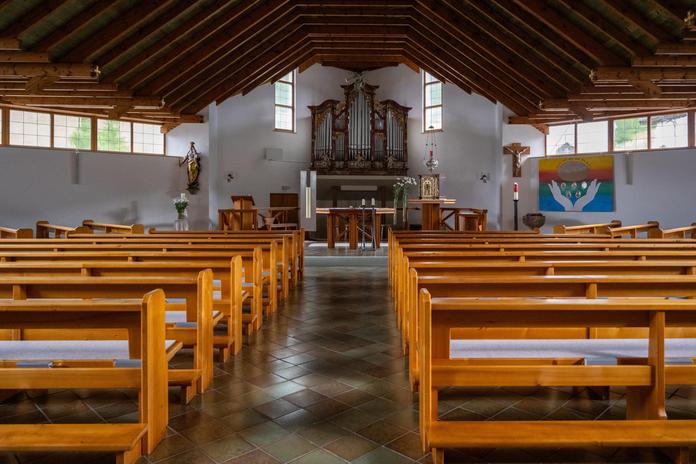
Count Hugo I of Montfort transferred the chapel with its associated properties to the Order of St. John with the condition that a hostel for passing travelers be built. The village and the Klostertal owe their names to this hostel, a so-called “Clösterlin.” We first learn of the patronage of Saint John the Baptist in 1332. This is – as is easy to see – attributable to the activities of the Order of St. John. The medieval church was replaced in 1609 by a baroque new building by the Feldkirch city stonemason Melchior Morscher. This church, in turn, existed until 1974. The tower, built in 1660 with a baroque onion dome, has been preserved. The “old” church of Klösterle received its baroque inventory in 1774, when new altars and a pulpit were acquired. The then parish priest Johann Josef Gaßner, who caused a stir as an exorcist and miracle healer, was responsible for this. He apparently used the donations from those seeking help for the new furnishing of the church. Only the former cross altar is still in Klösterle today, in the vestibule of the current church. After the Second World War, the baroque church soon proved to be too small and, above all, very dilapidated. Over the years, it became clear that only a new building (with the exception of the old tower) could provide a remedy, to which the Federal Monuments Office finally gave its consent. The only plan after a call for architectural competition was submitted by the almost 90-year-old Prof. Clemens Holzmeister, who had extensive experience with church buildings. The octagonal church building according to his plans was finally started in 1974. Two years later, the solemn consecration by Bishop DDr. Bruno Wechner took place. Valuable inventory from the old church was also used in the newly built house of worship. In addition to the mentioned baroque cross altar, these included the linden wood sculpture of the Mother of God from around 1630 (which is attributed to the Feldkirch sculptor Erasmus Kern) as well as baroque depictions of the twelve apostles and the Stations of the Cross. The organ is in a late baroque casing from 1766, with the small putti and trombone angels created by the Imst sculptor Josef Klemens Wittwer. The Pietà, which has found its place on the eastern church wall, may also be from his hand.
Opening hours & season
- 01.07.2023 – 01.12.2025So10:00–11:00
- 01.07.2023 – 01.12.2025Sa19:00–20:00
Map & directions
Anzeige
Events nearby
Upcoming events within 10 km.

Experiences
Tours & activities in Vorarlberg
Guided tours, tickets and experiences in Vorarlberg — bookable via GetYourGuide.