 Photo: Steininger Ute
Pfarrkirche Weyer
Weyer, Upper Austria
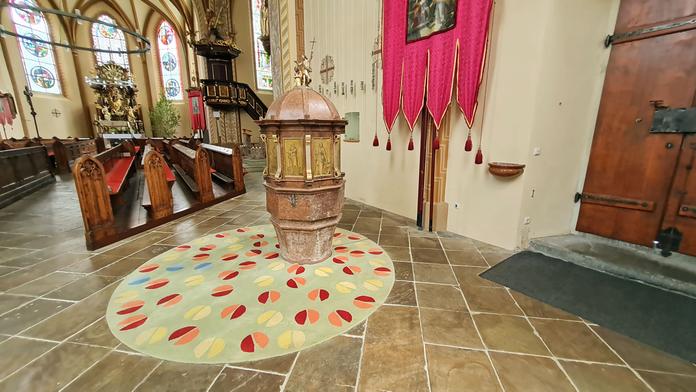
The church consists of a single-nave, four-bay, Gothic nave with a net-rib vault. The transept is two bays long on both sides with 3/8 closures. The lower part of the south tower dates from the Gothic period. The cross-vaulted tower chapel is decorated with stucco from 1745. The three-axis choir rests on cross-rib and star-rib vaults.Gothic frescoes are preserved in the church. One of them - the “Annunciation of the Lord” - dates from the first quarter of the 14th century. In the vault of the nave are the symbols of the Evangelists, which were created in the middle of the 15th century. Both frescoes were uncovered in 1949 and partially heavily restored.The four altars were almost destroyed by Turkish attacks in 1532. Among the newly erected altars, one was dedicated to St. Anna. In 1775, a new side chapel was built, and in 1881, a Lourdes grotto was created from the tower chapel. In 2004, during the renovation, the Marian altar was enhanced by a special arrangement of the benches and a candle table, and the Lourdes grotto was transformed into a “place of reconciliation,” a confession and discussion room.The high altar was created in 1661 (Christoph Matthäus Degenhart); it shows the parish patron John, the Evangelist, as a seer on Patmos at the feet of Mary. Changes were made to it in 1675 and 1755.In 1847, the late Gothic presbytery was demolished and rebuilt onto the old nave. Alongside the Maximilianskirche in Linz, it is the earliest Neo-Gothic building in the country. Particularly noteworthy is the Marian altar, which, along with the other three altars, was re-consecrated after the Turkish storm. In 1628, it received a “Mary with Child” by Hans Spindler as its main sculpture. This miraculous image “Maria Trost” (Mary Consolation) in Weyer developed into a pilgrimage site. The Anna altar shows a wooden sculpture of “Anna Selbdritt” (St. Anne with the Virgin and Child) (1535) and accompanying figures of St. John the Baptist and St. Leopold. The pulpit was documented as built in 1711 by the carpenter Bartholomäo Riedelsberger from Weyer. Several Baroque statues, some from the 17th century, are displayed in the nave. The church also contains a Gothic baptismal font, a Baroque holy water basin, and several Gothic and Baroque tombstones.The bell was cast in 1711.The history of the furnishings has been expanded with new objects by the sculptor Alois Lindenbauer, who lives in Weyer.The internationally renowned artist Siegfried Anzinger, born in Weyer, designed two stained-glass windows for the Weyer parish church. He conceived each window as a women's and men's window and marked them with the common symbol. Each window consists of six fields connected to form a unit.A detailed description of the motifs can be found on the Weyer parish website.
Map & directions
Events nearby
Upcoming events within 10 km.


Experiences
Tours & activities in Oberösterreich
Guided tours, tickets and experiences in Oberösterreich — bookable via GetYourGuide.