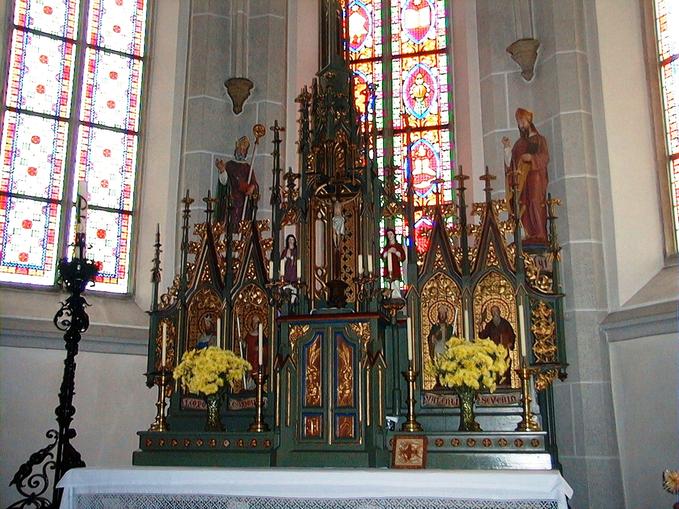
 Photo: Gemeinde Vichtenstein
Pfarrkirche Vichtenstein
Vichtenstein, Upper Austria
The beautiful parish church of Vichtenstein is located in the village center only a few meters off the Donausteig. The Neo-Gothic hall church captivates with a granite fan vault, symbolic decorations on the keystone, several stone "rosettes" in the church walls,... - see and discover! The total length is 33 m, the width 14.50 m, and the tower height reaches 40 m. The presbytery is illuminated by three large windows and the double nave by 6.50 m high windows. The highlight is the "Hausmutter von Vichtenstein", a miraculous statue of Mary. It was created around 1430 and originally stood in the castle chapel. After a fire in 1773, which destroyed a large part of the castle and its chapel, the wooden figure disappeared. Mysteriously, it reappeared in 1881 during the placement of the tower cross on the new parish church. The solution to the mystery: the wife of the castle's administrator had taken it without permission and only remorsefully returned it on her deathbed. Several miraculous healings are attributed to the statue, and thus it was a popular pilgrimage site for the local population for centuries. The Vichtenstein Castle has always been the stately center of the village. The ecclesiastical center, however, was located in Esternberg, about 6 km northwest, the oldest parish in the northern Sauwald. The chapel of Vichtenstein Castle thus served as a filial church until the 18th century. In 1785, Vichtenstein finally became an independent parish. The reason: according to Emperor Joseph II, no subject should have a difficult journey to their church. In 1877, the arduous construction of the present parish church began, which was completed with the solemn placement of the tower cross in 1881. Incidentally, the granite used for the church did not come from a quarry, but was found and processed in the surrounding forests. (Source: Schulz-Wulkow, K. (2012). Vichtenstein im Sauwald) Now the question arises: What is a hall church? In a hall church, the nave characterizes the church space. The naves are of equal height and usually united under a common gable roof. This creates a spacious, hall-like sense of space. Here in Vichtenstein, however, more static considerations were decisive for the two-nave architecture. Due to the steep hillside, the plateau for the parish church had to be partially filled. To relieve some of the vault pressure from the valley-side outer walls, three central columns were erected in the nave. Learn to read church architecture! Tip: A short detour to the parish church is worthwhile! By public bus: Linz – Engelhartszell – Kasten – Vichtenstein (Postbus); Passau – Vichtenstein By train: Passau or Schärding By ship: Ship landing stage Kasten: Reederei Wurm & Noé, D-94032 Passau, Höllgasse, Tel. +49 851 929292 By car: From Vienna/Linz: Linz – Eferding – Engelhartszell – Kasten – Vichtenstein (70 km) on the Nibelungen Bundesstraße B 130 From Munich/Passau: Autobahn exit Passau-Mitte – direction Engelhartszell B 130 – Kasten – Vichtenstein (18 km). From Salzburg: Braunau – Schärding – Vichtenstein on the Sauwald- Bundesstraße B 136. (Schärding – Vichtenstein: 20 km)
Map & directions
Anzeige
Events nearby
Upcoming events within 10 km.
Experiences
Tours & activities in Oberösterreich
Guided tours, tickets and experiences in Oberösterreich — bookable via GetYourGuide.