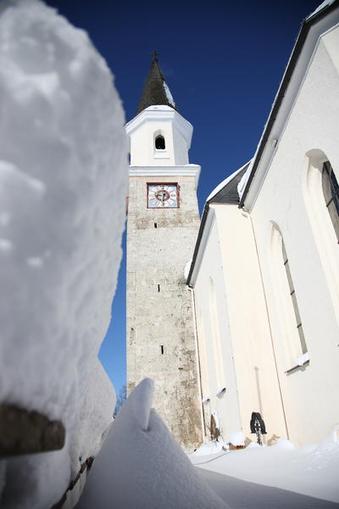
Pfarrkirche St. Sebastian
Hof bei Salzburg, Salzburg
First documented in 1502, it was a single-nave, Gothic hall church with late Gothic net vaults. The house of God is consecrated to Saint Sebastian. On August 4, 1859, a conflagration (caused by lightning) destroyed most of the church and the surrounding buildings. On October 12, 1878, the newly erected church was solemnly consecrated by Prince-Archbishop Albert Eder. In recent years, the church has been renovated and now shines in its original colors. In addition, heating ensures more pleasant temperatures in winter. The spacious mother parish of Thalgau, like other parishes since the mid-16th century, was divided into smaller units (vicariates, local chaplaincies). Hof bei Salzburg also became a vicariate in 1785. Hof bei Salzburg only became an independent parish in 1858. In 1859, the church burned down due to lightning. During the reconstruction, the tower was no longer built as an onion dome, but as an octagonal pyramid spire by court master carpenter Peter Huber. The tower height, including the cross, is 38 meters. The house of God is consecrated to the Holy Martyr Sebastian. The name comes from Greek and means "the sublime one." History and legends about his life are intertwined, as the original documents have been lost. He was an officer in the Roman military and was sentenced to death for his Christian faith during the reign of Emperor Diocletian (284-305). He is depicted with arrows stuck in his body. Since 354, his feast has been celebrated on January 20. In 1761, a prayer community, the Sebastian Brotherhood, was founded in honor of the patron saint of the plague. The old, beautifully equipped brotherhood book is still preserved. Hof bei Salzburg was a well-known pilgrimage site until the first half of the 20th century. Annually, a procession of supplication also took place from the city of Salzburg to the patron saint of the plague in Hof bei Salzburg. ("Nothing is more alive than a dead saint," quoted after P. Beda Müller). Among the approximately 40 pastors since the elevation to vicariate, Joseph Mohr is also included. A memorial plaque in the southern entrance room commemorates him. (Vicariate = pastoral care center of a mother parish, Provisor = in this case, pastor of the vicariate) According to the research of Pastor Andreas Radauer, Joseph Mohr, during his time in Hof bei Salzburg or in the following nine years in Hintersee, composed and set to music his own "Silent Night" song for children, of which two stanzas are still preserved. After the aforementioned fire, the church received a completely new interior in the Neo-Gothic style. The high altar from 1862, designed by Professor Hollweg from Munich and executed by the Salzburg sculptor Johann Scheidl, shows Saint Sebastian with two angels in the center, flanked at the same height by Saints Florian and George. Above them, on the right, is Saint Rochus (also a patron saint of the plague) and on the left, Saint Leonhard. At the very top stands a Sacred Heart of Jesus statue. The left side altar was made in 1873 by Georg Zuckerstätter from Fuschl am See. The Blessed Virgin Mary with the crown of stars is in the center, accompanied by Saint Rupert and Saint Elisabeth of Thuringia. In the tabernacle is the nativity scene from 1888 by the Gröden carver Franz Schmalzl. The right side altar dates from 1890 and is dedicated to Saint Joseph. He is flanked by Saint Peter and Saint Paul. In the niche above, stands Saint Anthony of Padua. The structure was created by Joseph Stumpf from Kufstein, who also made the pulpit with the half-reliefs of the four Evangelists and the choir stalls. The figures of the altar, as well as those of Saint Francis Xavier opposite the pulpit, were created by Joseph Rifesser from Gröden. On the north side of the altar area is a large cross of unknown origin (presumably 19th century, not in the inventory) with statues of Mary and Mary Magdalene. The beautiful Baroque processional cross (carrying cross), however, was presumably created around 1730 by Paul Mödlhammer from Neumarkt. In the altar arch, statues of Saint Anne and Saint Aloysius (also by Rifesser) can be seen. Also noteworthy are the beautiful statue of Saint Cecilia carved by the Hof master sculptor Franz Wesenauer and his restored old statue of Saint Barbara on the gallery next to the organ pipe set (Rückpositiv) on the balustrade. The 14 panels of the Stations of the Cross from 1867 are by the masters Josef Führich, Georg Hitzl, and Martin Klotz from Salzburg, as well as Georg Tiefenthaler from Seekirchen. The old organ came from Salzburg Cathedral and was bought back by the cathedral parish in 1981, after the installation of a new organ (Dreher-Reinisch company, Salzburg). Particularly impressive is the artistic Gothic church portal from 1506, made of Adnet marble, which has been preserved from the old church. In the gable field, there is a beautiful relief with Saint Sebastian, Saint Leonhard, and Saint Barbara. On the far left is the coat of arms of the "Kirchpüchler." The name of this extinct family lives on in the Kirchbichl farm. The war memorial dates from 1922, and the cemetery cross was created by Franz Wesenauer in 1993. As a result of the two World Wars, the bells were removed and melted down twice. The current peal has four bells: the old death knell from 1860, and three new bronze bells from 1949 (E, G, A - 1041 kg, 618 kg, and 439 kg, all from the Oberascher company). The church has already undergone many restoration works, and the cemetery, which was established in 1801, has also had to be expanded several times. Most recently, under Pastor Mag. Joseph Sams, an extensive renovation program was initiated (redesign of the baptismal font, church heating, sacristy, painting, among others). Those interested in learning more about the church are referred to the article by Josef Felber in the C
Opening hours & season
- 15.08.2020 – 31.12.2070daily08:00–18:00
Map & directions
Anzeige
Events nearby
Upcoming events within 10 km.


Experiences
Tours & activities in Salzburg
Guided tours, tickets and experiences in Salzburg — bookable via GetYourGuide.