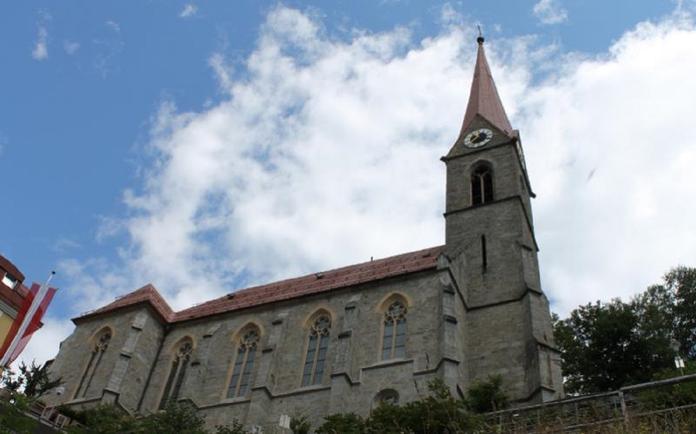
Pfarrkirche Bad Gastein
Bad Gastein, Salzburg
Construction history and architectural design: The first documented mention of a church at this location dates back to 1333. In 1617, the medieval building had to be demolished due to structural issues, and between 1636 and 1638, a complete new construction was carried out, with plans provided by cathedral master Santino Solari. Since the church is situated on a slope of the Graukogel, extensive renovation works were repeatedly necessary, notably in 1699, 1723 (rebuilt), and 1824. In 1866, construction of a new church began. The plans were created by the Viennese cathedral master Friedrich von Schmidt but were significantly altered by the Salzburg master builder Valentin Ceconi. After ten years of construction, the parish church was consecrated on November 27, 1876. Between 1990 and 1995, it was again extensively secured with technical measures. Externally, the Bad Gastein parish church appears as an unplastered ashlar building. The nave comprises four bays and is covered with a cross-rib vault. The northern bay is expanded transversely and features a ridge vault. The choir has a five-sided termination. In the southern bay, there is a three-aisled gallery with a tracery balustrade. The High Altar: The high altar was created in 1954 by the sculptor Jakob Adlhart from Hallein, based on specifications from Pastor Gottfried Schwarzenbacher. The centerpiece is a high-quality, polychromed late Gothic figure of the Mother of God with the Christ Child (1450/70), surrounded by a halo of rays. Originally from the Nikolauskirche, the altar also features two early Baroque statues of St. Rupert (with the salt barrel) and St. Virgil (with the model of the cathedral). Adlhart's silvered relief panels combine the historically transmitted martyrdom of the two patron saints, Primus and Felicianus, with the founding legend of Bad Gastein. The ambo (birth of Jesus) and the celebration altar (descent from the cross) are also decorated with reliefs from the school of Master Adlhart. Side Altars: In 1953/54, the neo-Gothic side altars were dismantled, except for the marble mensa. Simple background panels were installed, and two baroque figures from elsewhere were placed: on the left, a Suffering Christ attributed to Meinrad Guggenbichler (1649-1723), and on the right, St. Joseph with the Jesus Child, from an anonymous baroque sculptor of the 18th century from the South German-Austrian region. Additional furnishings: The windows in the choir were designed in 1953 by Josef Widmoser. They depict biblical "water scenes": the left window shows Jesus healing the paralytic at the Pool of Bethesda in Jerusalem (John 5:1-9), and the right depicts the calling of the first disciples at the Sea of Gennesaret (Luke 5:1-11). The Stations of the Cross reliefs date from the time of construction. Above the marble baptismal font from 1876, located at the entrance to the altar area, hangs a 2007 icon of the two patron saints. The organ was built in 1874 by the Salzburg organ builder Matthäus Mauracher Sr. Below the organ loft are paintings of "Mary of Perpetual Help" (19th century) and "St. Thérèse of Lisieux" (20th century), as well as sculptures of St. Anthony of Padua (20th century) and St. Jude Thaddeus (18th century). Memorial plaques in the tower vestibule commemorate the benefactors of the church's reconstruction from 1866 to 1876.
Opening hours & season
- 19.05.2030dailyopen all day
Map & directions
Events nearby
Upcoming events within 10 km.

Experiences
Tours & activities in Salzburg
Guided tours, tickets and experiences in Salzburg — bookable via GetYourGuide.