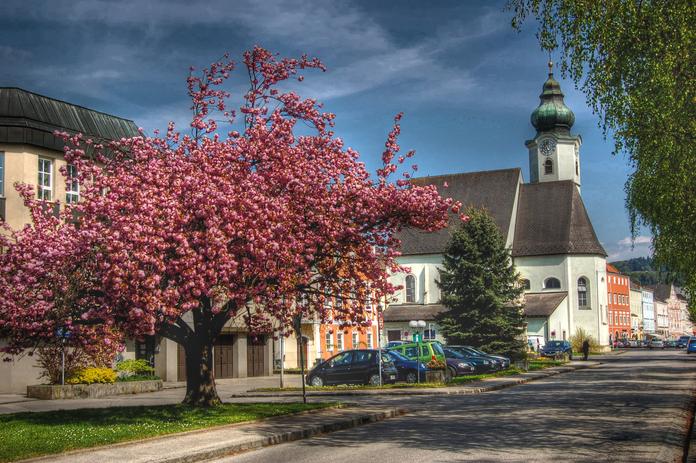
 Photo: Tourismusverband Aschach
Pfarrkirche Aschach an der Donau
Aschach a.d. Donau, Upper Austria
The parish church with the "miraculous" Danube cross and the crib boat. The name of the village Aschach is already mentioned in 777 in the foundation charter of Kremsmünster Abbey. The history of the parish church of Aschach can be traced back to the 14th century. There were houses of worship in Aschach even before the parish constitution in the 11th century. In the Schaunberger Urbar (register of feudal dues) of 1371, two churches are mentioned: the "chirchen", which is our parish church, and "sand Larentzen", which is the hospital or cemetery church. Count Siegmund Schaunberger had a late Gothic building erected in 1490. The rising masonry constitutes the greater part of the building fabric of the present parish church. A consecration inscription carved in stone from the year 1490 is immured above the sacristy door. It states that this chapel was consecrated in 1490, on the Tuesday before St. Pancras' Day, and that regular services were celebrated from the Thursday before St. Urban's Day. It is noteworthy that this is one of the first church inscriptions in German and Gothic script. The house of God was consecrated to John the Baptist and Bishop Nicholas. For a long time, it was a filial church of the parish of Hartkirchen. Only in 1784, by a government decree of Emperor Joseph II, was Aschach separated from the mother church and elevated to an independent parish. The Baroque transformation of the late Gothic church had already begun before that. The Baroque dome helmet was already placed in 1750. Due to its proximity to the Danube, the building was repeatedly affected by floods and ice floes. It often happened that the masses of water penetrated the church. In some cases, the water reached up to 1 meter above the church pews. These catastrophes caused great damage to the masonry and wood, and therefore repairs were always necessary. However, in 1693 there was an event that provided the house of God with beautiful additional inventory. In that year, there was another flood. Two boatmen discovered a heavy wooden cross with the painted crucified figure and brought it ashore. The sickly Stefan Mitterbauer took care of the artwork and had it renovated. During this work, he became completely healthy. He associated his healing with the cross. Thereupon it received the name "Danube Cross" or "miraculous cross". When it was completely restored in 1701 and had received Baroque decorations, it was placed above the high altar. In 1789, an ice floe again caused great damage to the parish church. The inhabitants of Aschach asked the district office for financial support, which was, however, refused. The suggestion was made to demolish the desolate old house of God and to elevate the Laurentius Chapel to a parish church. But the population of Aschach decisively rejected this request. With much strength and great effort, the new sacristy was added, the second gallery for the organ and singers was installed, and the nave was rebuilt. To protect against possible ice floes, the pastor had the so-called "Zugebäude" (annex) erected on the north side of the church in 1844. An altar and the Holy Sepulchre were placed in the newly gained space. Thus, a narrow Gothic nave had become a Baroque one. Inside, the gaze first falls on the high altar. The painting, by an unknown Spanish master, shows the enthroned Mother of God with the two church patrons, John the Baptist and Bishop Nicholas, surrounded by three angels. The painting was donated by the patron, the Austrian ambassador in Madrid, Ferdinand Bonaventura Count Harrach. An artwork from the 15th century can be seen in the chancel. It is a marble relief depicting Jesus on the Mount of Olives. As was customary at the time, coats of arms of important families are affixed to it. Time has also left its marks on this church. Therefore, in this century, a renovation and expansion of the house of God became necessary. For this, Prof. Dr. Clemens Holzmeister was engaged in 1973. He succeeded excellently in meeting the requirements of monument preservation, local landscape protection, and liturgy. To provide space for even more people, a breakthrough with an extension was made on the south side. Furthermore, the roof truss was repaired and the roof renewed, the exterior facades and the tower were re-plastered. On the outside towards the Danube, two fresco paintings commemorate the two church patrons: John the Baptist and Bishop Nicholas. The new windows were designed with antique glazing. The high altar had to be re-gilded and re-painted. Side altars and organ required restoration. Prof. Dr. Holzmeister designed the chandelier that now adorns the church interior. These and other renewals make the church shine in its present splendor. On December 11, 1977, Auxiliary Bishop A. Wagner was able to carry out the solemn re-opening and consecration. In 1984, the sculptor Ägydius Gamsjäger created the "Kripperlboot" (crib boat). This hand-carved relief has relocated the Christmas story to the Danube. It can be seen in the church all year round. The already mentioned Laurentius Chapel is located in the middle of the cemetery and was converted into a mortuary in 1987. The building structure and the entire rising masonry belong to the Romanesque era. It has long been suspected that the church actually goes back to Roman roots, which the Laurentius patronage could also indicate. During excavations by the Federal Monuments Office, mighty, 2-meter-deep foundations made of hewn ashlar stones were found, which were covered with traces of lime mortar. In the west wall, consisting of reddish granite ashlar stones, there is a remarkable Gothic pointed arch portal. The high altar shows an altarpiece of Saint Laurentius. This text and the pictures are taken from the book "Kirchen, Klöster, Pilgerwege und Österreich - Sakrales Kulturgut in Oberösterreich" by Franz R. Vorderwin
Map & directions
Anzeige
Events nearby
Upcoming events within 10 km.


Experiences
Tours & activities in Oberösterreich
Guided tours, tickets and experiences in Oberösterreich — bookable via GetYourGuide.