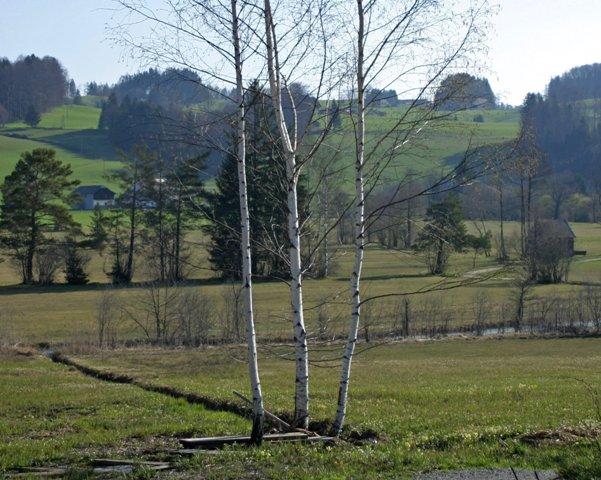
Ostseite Moor
Hof bei Salzburg, Salzburg
The meadow pipits return as early as mid to late March. Around the same time, the Eurasian curlew also arrives, audible with its loud, flute-like call. By the end of April, the whinchats are back. They breed on the moorland floor with up to ten pairs. They build their nest from dry grass stalks, fine roots, moss, and withered leaves, usually on the ground next to a larger perennial such as a globeflower or similar. The female lays 5 or 6 deep blue-greenish eggs, and after an incubation period of 13 days, the young hatch. After about 12 days, they leave the nest on foot and scatter individually in the long grass. Only after another 5 days are they able to fly. This behavior is their strategy against nest predators, who are always waiting for a favorable opportunity. The young birds then remain in the breeding area for another 4 weeks before slowly moving towards Africa, where they overwinter south of the Sahara. The recapture of ringed birds has proven that more than half of our breeding whinchats were also born here. During bird migration (spring), the song of the nightingale can be heard east of the path in the bushes. Along the path, several orchid species can also be admired (marsh helleborine, early purple orchid, sword-leaved helleborine, greater butterfly-orchid, etc.), all of which are under nature protection.
Opening hours & season
- 14.08.2020 – 31.12.2070daily06:00–22:00
Map & directions
Events nearby
Upcoming events within 10 km.



Experiences
Tours & activities in Salzburg
Guided tours, tickets and experiences in Salzburg — bookable via GetYourGuide.