 Photo: Lechner Monika BRM
Kirche St. Ulrich
Bad Kleinkirchheim / St. Oswald, Carinthia
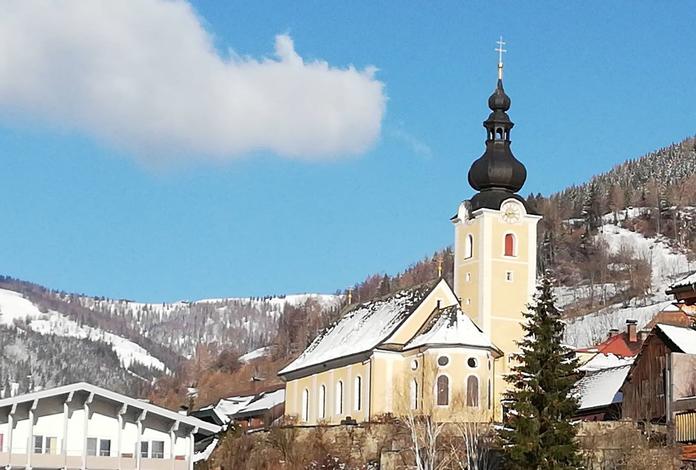
After a fire in 1743, a far-reaching redesign took place. Renovations to the church are attested from the years 1806 and 1837. The last restoration took place in 1957. Exterior appearance: The simple 4-axis nave has a high gabled roof, adjoined by a lower choir with a 3/8-closure. To the north stands the squat tower with an onion dome. The structure's masonry is Romanesque-Gothic, while the windows, the west portal, and the delicate pilasters on the nave and choir are Baroque. The pointed-arch north portal from the Gothic period is still preserved. The interior of the church: In the western entrance area, a wooden music gallery rises with saints in grisaille painting on the balustrade (18th century). The broadly proportioned hall nave with an undivided barrel vault over narrow cornices is adorned with rich painting: Rocaille medallions with depictions from the legend of St. Ulrich and the Battle of Lechfeld, painted between 1926 and 1928 by Jonas Ranter. On the north side are two Riester tombstones, dated 1718 and 1604 respectively. On the south side of the nave, a Baroque fresco from 1768 can be seen, depicting Christ on the Mount of Olives. The crucifixion group on the southern nave wall dates from the first quarter of the 18th century. The recessed triumphal arch is architecturally structured by pilasters with an entablature. The painting in the choir and above the triumphal arch is also by Jonas Ranter. In the shallow dome, the Transfiguration of St. Ulrich can be seen, executed by Karl Winkler in 1837. The painted ornamental and architectural structural elements, as well as the depiction of St. Joseph with the infant Jesus from the beginning of the 19th century, were only discovered in 1988. In the northern choir wall, an iron-clad late Gothic door leads to the sacristy in the tower's ground floor. The altars and the pulpit are stylistically classified in the first quarter of the 18th century. The two paintings on the main altar show the patron saint of the church on one side, and Madonna with the infant Jesus and St. John on the other. Above the processional portals stand the carved figures of Saints John Nepomuk and Francis Xavier. On the left side altar, John the Baptist (bottom) and Ignatius of Loyola (top) are depicted, and on the right side altar, Erasmus and Leonard (bottom) and Francis Xavier (top). The three bells date from the 13th century and 1664 respectively.
Opening hours & season
- 03.12.2018 – 31.12.2026daily09:00–19:00
Map & directions
Anzeige
Events nearby
Upcoming events within 10 km.


Experiences
Tours & activities in Kärnten
Guided tours, tickets and experiences in Kärnten — bookable via GetYourGuide.