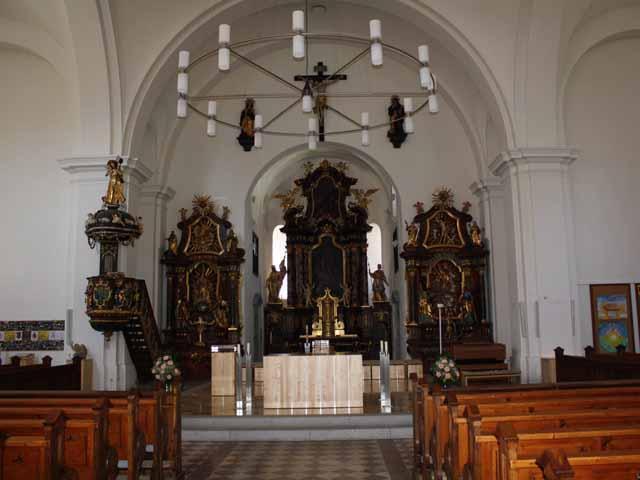
 Photo: Tourismusbüro Ebensee, Spengler
Katholische Pfarrkirche Ebensee
Ebensee, Upper Austria
The history of Ebensee's local development received a decisive impulse with the start of construction of a "Pfannhaus" (a saltworks) in 1604, because until the saltworks was built, there were only 5 houses in the current center. Ecclesiastically, the town belonged to the Traunkirchen monastery for a long time. It was not until 1726 that Emperor Karl IV approved the construction of its own church "in der Lambat". In 1729, the house of God, designed by the Linz Baroque master builder Johann Michael Pruner and consecrated to Saint Joseph, was consecrated as a filial church of Traunkirchen. It was elevated to a parish 57 years later by Emperor Joseph II (1786). In 1835, a major fire destroyed the saltworks building and also the wooden church tower, which was rebuilt with solid masonry in 1841. In 1910/1911, the church was extended under the direction of cathedral master builder Schlager from Linz. The last renovation of the parish church took place between 1999 and 2004 (exterior renovation 1999 - 2001, interior renovation 2002 - 2004). During the interior renovation, far-reaching changes were made in the spirit of the renewed liturgy after the Second Vatican Council. The side altars were moved back to their original place and the side pews were turned towards the center of the church (Volksaltar - people's altar). The former sacristy is now the Sacrament Chapel. Our organs: In 1770, the parish church received its first small organ. Already in 1810 (or 1811), it was replaced by a larger one. The old one was probably reused in the Kalvarienbergkirche in 1813. The second organ had to be dismantled in 1910 due to the expansion of the church space. It continues to serve in the Protestant church in Hallstatt to this day. For the next few years, a harmonium had to take the place of an organ until an organ built by Ludwig Mayrhofer from Linz could be acquired in 1924. Due to the economic situation, however, inferior minerals were used for its construction, so that a new building had been considered since the 1960s. In 2005, an organ committee was formed, which specifically aimed for a new building. In 2012, the new organ, built by the Pirchner company from Steinach am Brenner, was installed and consecrated in the old but renovated casing. On the current design of the altar area and the Sacrament Chapel: The artist Herbert Friedl from Pregarten wanted to contrast the existing Baroque splendor with elements reduced to the simplest form. The Volksaltar, as the central place of the Eucharist celebration, stands in the center of the church, around which the celebrating community gathers. The wooden beams, joined together to form the altar, are intended to express the living community of faith. A special feature is the processional cross: its beams are made of untreated wood from a barracks of the Mauthausen concentration camp. This is intended to point out that during the Nazi era, Ebensee was home to one of Mauthausen's many subcamps, and thousands of people suffered and died here. Art treasures in our parish church High altar: late Baroque, made in Innsbruck in 1744. The wide predella bears the figures of Saint Leopold and Saint Charles Borromeo. The central piece shows the shrine image of Saint Joseph, the patron saint of the church. It is an oil painting in dark brown from the Passau Cathedral treasure by Joh. Georg Dom. Grasmair, created in 1764. The altar retable is supported by six columns with typical late Baroque capitals. In the center is an oil painting depicting "God the Father". The strongly emphasized movement and counter-movement in the plastic part of the retable are remarkable. It experiences its greatest intensification in the two angel figures. Side altars: Baroque, created in 1740, they are said to have come from a Tyrolean monastery, the Women's Altar on the left, the Antonius Altar on the right. The shrine and retable formerly contained oil paintings. These were replaced by sculptures during a renovation (1937) in the Rauch workshop, Altmünster, which gave the two altars greater artistic significance. Pulpit: It is a work by the sculptor Franz Anthoni Koch from Mondsee, created around 1730. The stair railing and the pulpit itself form a harmonious unit. The dome bears a particularly beautifully set gilded wooden sculpture, the "Good Shepherd". The sculpture was created in the workshop (or by) Meinrad Guggenbichler. Crucifixion group in the chancel arch: Baroque, approx. 1700. Monstrance: made of gilded silver, set with precious stones. It weighs 2.5 kg and is probably a donation from the salt administrator Josef Anton Sydler von Rosenegg (administrator from 1710 to 1741). Christmas crib: a special attraction is the crib set up at Christmas, which is rearranged several times. The manufacturer is unknown, the figures are probably from the "Kremsmünsterer School" (around 1750). The overall work is impressive.
Opening hours & season
- 24.12.2020 – 24.12.2030daily08:00–17:00
Map & directions
Events nearby
Upcoming events within 10 km.

Experiences
Tours & activities in Oberösterreich
Guided tours, tickets and experiences in Oberösterreich — bookable via GetYourGuide.