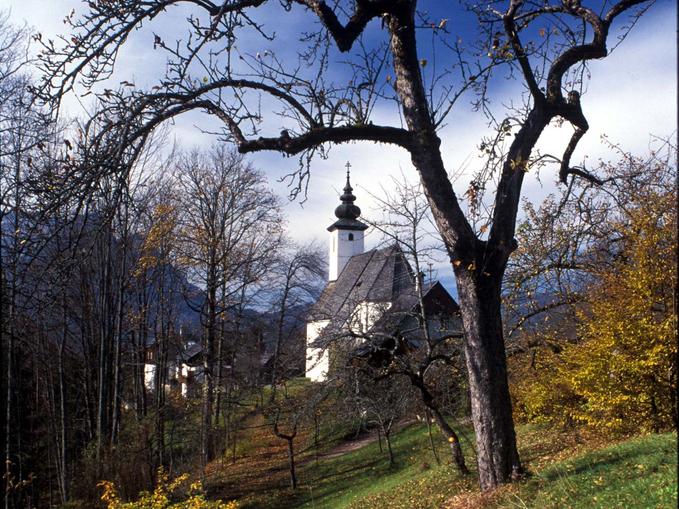
 Photo: TVB Ausseerland - Salzkammergut_Pirker
Kalvarienbergkirche St. Leonhard
Bad Aussee, Styria
Gothic elements are still visible today in the church portals, the sacristy door, the chancel arch, and the border of the offering box on the outside of the church. On the north and south interior walls, there is a small wrought-iron door each, which used to lock the offering boxes, located on the exterior wall of the church, from the inside. These were used during the time of salt transport, when carters transporting salt over the Radlingpass towards the Ennstal would deposit their offerings here for a safe journey. At that time, there was also a 3 x 1.5 meter fresco on the south exterior wall of the church, depicting St. Christopher with a green staff, red cloak, and the Christ Child on his shoulder. It also promised protection to passing travelers who did not have time to enter the church. Christopher is not only considered the patron saint against plague, unforeseen or unrepentant death, but also the protector of pilgrims, travelers, and porters. In 1732, a new sacristy was presumably added to the church, covering the Christopher fresco. Today, it is well-preserved and visible in the attic area. The four panel paintings, painted on both sides and pivotably attached to the organ gallery, are also of medieval origin. They show eight scenes from the Leonhard legend. It is presumed that the panels originate from the original high altar from the mid-15th century. However, only copies are visible today. The originals are on loan to the Diocesan Museum in Graz. Further witnesses to the church's Gothic origin are a statue of Mary with child, which shows traces of alteration, and a statue of St. Koloman. The latter came into private ownership after the Baroque transformation and was able to be repurchased for St. Leonhard in the 1970s. The Gothic bell arrived in St. Leonhard in the 15th century. It is assumed that during the Reformation, it was used for profane purposes in the old Hofkasten (courtyard granary). This later had to make way for the new savings bank building, erected in the Neo-Renaissance style, which today houses the political branch office. After its rediscovery, it was ceremoniously returned to the St. Leonhard church on October 26, 1980. In 1984, the Leonhard church received a new, second bell in place of the old steel bell. From 1711 to 1732, the Leonhard church was rebuilt. A new tower with a Baroque dome was erected. The tall Gothic pointed arch windows were converted into smaller, rectangular windows with segmental arches. Thus, the church's exterior lost its Gothic character. The interior received a barrel vault with lunettes and a half-dome in the apse. Today, the Leonhard church presents itself as a Baroque-decorated Calvary church. If one follows the steeply ascending "old salt road" or Radlingstraße from the parish church of St. Paul in Bad Aussee, it leads past two cross pillars and four stations of the Sorrowful Rosary to the Leonhard church. The first three stations are round chapels with shingle-covered dome roofs, built between 1732 and 1748. Their frescoes are severely damaged by moisture. The figures of the "Flagellation" (second chapel) and the "Crowning with Thorns" (third chapel), as well as the large crucifixion group of the Calvary altar, come from the workshop of the Mondsee sculptor Franz Anton Koch. Whether the figures of the first station chapel at the beginning of the Radlingstraße (Christ praying on the Mount of Olives with the three sleeping disciples) are by the same artist cannot be proven. In the fourth station chapel, which is architecturally different from the three round chapels, the Carrying of the Cross is depicted in a large mural. The Leonhard church itself, with the high altar designed as a Calvary, represents the fifth station. The crucifixion group shows Christ and the two thieves, the Mother of God, St. John, and in place of St. Mary Magdalene, St. Leonhard. The completely redesigned apse was painted with a large fresco (1731). The two side altars (Koloman altar on the right and Three Kings altar on the left) are dated 1740 and were restored in 1862. The former shows a painting depicting the martyrdom and glorification of St. Koloman. It is flanked on the left by St. Maximilian and on the right by St. Confessor Bishop Valentin, whose attribute (a cripple lying at his feet) was stolen. On the altar top, we see Paul and Aegidius. The painting of the Three Kings altar shows the Adoration of the Magi. To the right and left of the altarpiece stand the statues of St. Anna and St. Joachim. The altar top shows God the Father and the Holy Spirit, flanked by figures of Zacharias and Elizabeth. The pulpit comes from the workshop of the well-known artist Johann Ignaz Thenni, originally from Vienna and residing in Altaussee, and was erected around 1742. On its balustrade were the four great Latin Church Fathers and the four Evangelist symbols. Unfortunately, the sculpture of St. Ambrose fell victim to theft. On the sounding board, we see the Good Shepherd, at whose feet sit three angels with the symbols for Faith (cross and chalice), Hope (anchor), and Love (heart). On the northern exterior wall, we can still see a fresco of St. Leonhard with a protective roof, which presumably goes back to one painted by Georg Andre Faber in 1672. The painting of the two church portals presumably dates from the 19th century. Right next to the sacristy, on the exterior wall of the church, one can visit a so-called Schalenstein (cup-marked stone). Its function has not yet been scientifically clarified. For the stone at the Leonhard church, there are three legends of its origin - one reports that it received its shape because the Mother of God rested on it during her wanderings.
Map & directions
Anzeige
Events nearby
Upcoming events within 10 km.

Experiences
Tours & activities in Steiermark
Guided tours, tickets and experiences in Steiermark — bookable via GetYourGuide.