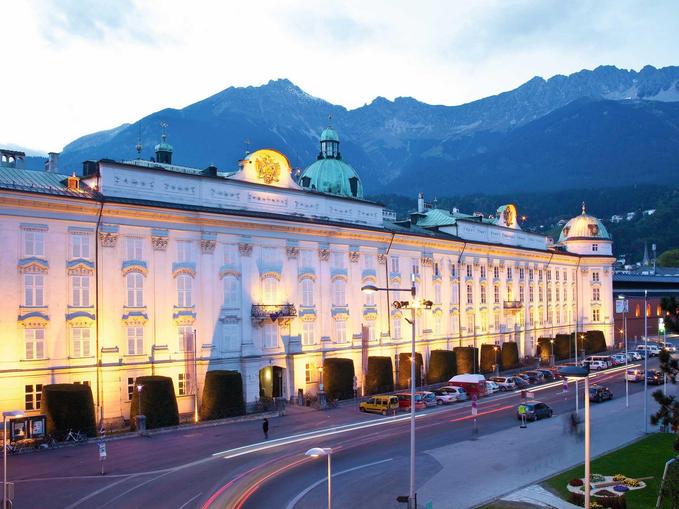
Kaiserliche Hofburg
Innsbruck, Tyrol
In 1500, the Hofburg Innsbruck was completed under Emperor Maximilian I (1459-1519). It already had the same dimensions as today and was captured in an aquarelle by Albrecht Dürer. The painting shows a late Gothic inner courtyard with a covered staircase, the coat of arms tower, and the Frauenzimmer, called the "Frauenzimmer". There was a large reception hall designed as a hall with columns and vaults, which is now called the "Gothic Cellar." A "Kürnstube," where Maximilian's hunting trophies were stored, a "Silberkammer" (treasury), and a banquet hall with Hercules depictions are also documented. The "Rennplatz" in front of the Hofburg served as a tournament ground for the sport-loving emperor. Almost 250 years later, Maria Theresa (1717-1780) visited the Imperial Hofburg Innsbruck and found it outdated. Since 1665, there were no longer any Tyrolean land princes, and the governors, who now ruled Tyrol on behalf of the emperor, inhabited the first floor (Statthalterei). The representative rooms on the second upper floor, reserved for the imperial family, remained unoccupied. The ruler ordered a renovation in the style of Viennese late Baroque and sent her best artists to Innsbruck: Konstantin von Walter and Nicolaus Parcassi. For the interior, Martin van Meytens and his school, as well as Franz Anton Maulbertsch, were commissioned. The renovation was interrupted by the Seven Years' War, so it extended into the 1770s. The decision by Maria Theresa to hold her son Leopold's (II) wedding with Maria Ludovica of Bourbon in Innsbruck in 1765 was like a move, as everything from furniture to porcelain and tableware had to be organized. The wedding on August 4 was celebrated with 2,000 guests in a lavish ceremony (mostly just "spectators" who were not fed). The festivities lasted 14 days with elaborate meals, operas, and entertainment until August 18, 1765, when the sudden death of Emperor Franz I. Stephan abruptly ended the celebrations. Maria Theresa mourned her beloved husband deeply: he was laid out in the Riesensaal after the usual Habsburg mourning ceremonies and then transferred by ship to Vienna, where he was laid to rest in the Kapuzinergruft. Maria Theresa converted his death chamber into a new chapel, built the Triumphpforte with a mourning and wedding side, decorated it with plastic ornaments, and founded a ladies' monastery where twelve noble Tyrolean women prayed several hours daily for the deceased emperor. This last survived all the upheavals of history and still exists today in a smaller form. In the 19th century, Archduke Karl Ludwig (1833-1896) was governor in Innsbruck and had the so-called Inner Apartment redesigned for his sister-in-law, Empress Elisabeth (Sisi). Furniture in the style of the Second Rococo was brought from the Viennese court artist August La Vigne, with each room painted in a different color. The exquisite silk fabrics decorated furniture, served as wall coverings, and curtains. Elisabeth stayed in Innsbruck only a few times, while her husband Emperor Franz Joseph regularly visited Tyrol and stayed at the Hofburg. With the end of the monarchy in 1918, the former imperial property became state-owned. The Burghauptmannschaft now manages Austria's third most important historic building. Between 2006 and 2010, the third and final part of the Hofburg's comprehensive renovation was completed. It is frequently used for high-level events. Visiting: 1. State Rooms (Maria Theresa style) GARDEN HALL: Large-format battle paintings with Karl V. of Lorraine (Turkish Wars), imperial general and first governor of Tyrol, married to Eleonore of Habsburg. Grandparents of Franz Stephan (Emperor Franz I.) RIESENSAAL: The most important banquet hall in Western Austria, a memorial culture of the Habsburgs: remembrance of Maria Theresa, Franz Stephan of Lorraine, and their 16 children (full-figure portraits by Martin van Meytens and school). After 1765. Ceiling frescoes by Franz Anton Maulbertsch around 1770 with themes "Union of the Habsburg & Lorraine dynasties" and "The Regalia of Tyrol". It is still used today as a banquet hall. RATSZIMMER: The three most important orders are depicted: the Order of St. Stephen, the Order of the Golden Fleece, and the German Order. 2. Imperial Apartments: Salon, beauty salon, writing room, dressing room, bedroom, each in different colors, furniture and room design, second half of the 19th century. 3. Chapel and chapel vestibule, sacristy (Maria Theresa style): themes of wedding and death 1765. CHAPEL: Second half of the 18th century, high Baroque group of figures by F.A. Leittensdorffer. 4. Coat of Arms Tower (mainly Maximilian's core), decorated with the coat of arms of Emperor Maximilian I on the Hofkirche side, clad during the Baroque renovation (today corner rotunda). Dürer views of the late Gothic Hofburg (facsimile), floor plans.
Opening hours & season
- 04.02.2025 – 21.09.2025daily09:00–17:00
Map & directions
Events nearby
Upcoming events within 10 km.
Experiences
Tours & activities in Innsbruck
Guided tours, tickets and experiences in Innsbruck — bookable via GetYourGuide.