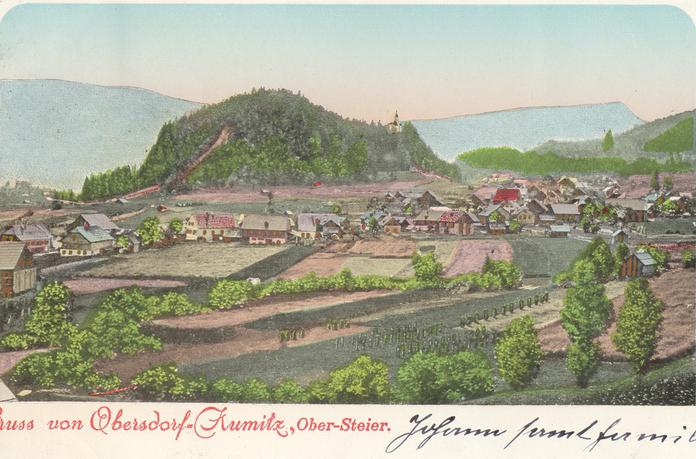
 Photo: Quelle: Archiv Schloss Trautenfels, UMJ
Hinterberger Panoramaweg - Station Bauernhalt
Bad Mitterndorf, Styria
Watershed KumitzbergThe Kumitzberg forms the watershed between the catchment area of the Traun in the western part and the catchment area of the Enns with the Salza and the Grimmingbach in the eastern part of the Hinterbergertal. There was a special feature in the formation of the medieval ecclesiastical mission and administrative areas. The borders of the former large dioceses of Salzburg and Passau seem to have obviously oriented themselves along the watershed running through the valley at Kumitzberg, for which there are no direct sources, but indications. When the Carantanian March was separated from the Duchy of Bavaria and upgraded to the Duchy of Carinthia in 976, the Traun catchment area with Aussee and Kainisch remained with the ecclesiastical province of Passau. Mitterndorf belonged to the mission and church administration area of Salzburg.Maria KumitzMarian veneration and Baroque art shaped ecclesiastical-cultural life in the 18th century. During this time, Maria Kumitz emerged as a place of pilgrimage. According to a folk legend, the place owes its origin to the Mitterndorf parish priest Balthasar Marinz, who remained unharmed after falling from his horse near Kumitzberg and for this reason made a vow for the construction of a chapel. When he had a Way of the Cross and a chapel built in 1717, the foundation stone for the future pilgrimage site Maria Kumitz was laid. Between 1766 and 1779, the church named “To the Seven Sorrows of Mary” was built, completed by the Mitterndorf parish priest Matthäus Strenberger. In 1788, Maria Kumitz received the status of a parish. The parish district included the villages of Kainisch, Pichl, Mühlreith, Knoppen and Obersdorf. Already in the first years of its existence, there were numerous inns and a strong influx of pilgrims around the church.The writer Herbert ZandHerbert Zand, born in Knoppen in 1923 into a small farming family, is one of the most important, albeit little-known, writers of Austrian post-war literature. Through attending secondary school in Bad Aussee, he gained access to the literary and art scene of the Aussee summer retreat and discovered his love for literature. In his youth, he was drafted into the Second World War on the Eastern Front and severely wounded. After his return, he sought connection to the Austrian literary scene. He was to form a close friendship with Elias Canetti in particular, despite few direct contacts. From 1954, Zand worked as a publishing editor in Vienna. From 1961, he worked for the Austrian Society for Literature, which looked after local authors and established contacts with writers of the former monarchy and exiled authors. In addition to his writing, Zand also translated texts by authors such as Anaïs Nin, Henry Miller or André Malraux into German. Between 1954 and 1970, Herbert Zand lived and worked as a writer in Vienna, repeatedly interrupted by stays of several weeks in his home in Knoppen. Zand's core themes included the traumatic experience of war, death and the hopelessness of a generation born after the First World War and who had “gone through the Second World War”. For him, the experience of this era culminated in an existential crisis of man. One of his most famous novels was “Letzte Ausfahrt” (Last Exit) (1953). Herbert Zand is considered a key representative of existentialist literature, awarded numerous prizes. He died at the age of 47 in 1970 in Vienna from the consequences of his war injury.Historical Salt Mining - HaulageWith salt mining, a distinct haulage system developed, in which Hinterberg carters were also involved. House names such as “Samer” (e.g. Obersdorf 47, Zauchen 20, Pichl 3) still bear witness to this tradition. From Aussee, the salt road led through the Stein or over the Klachau into the Ennstal. The Aussee salt supplied Styria, East Carinthia, and peripheral areas of Upper and Lower Austria. Salt transports were carried out by porters, pack animals, carts and horse-drawn wagons. Due to the traffic conditions and transport techniques at the time, winter was more suitable for transport than the rest of the year. Carters, innkeepers and the barrel-making trade had better earnings in the cold season. As the transport routes in the main Alpine valleys were expanded, the previously important passes in the side valleys, such as in the Sölktal, lost their importance, and with them the pack animal system as a secondary source of income for many farmers. Salt transport was constantly improved until haulage came to a standstill with the age of the railway.Hans FraungruberReading the descriptions of the generation of local poets at the beginning of the 20th century, one notices their focus on the small world of “Heimat” (homeland), which is contrasted with an uncertain and conflict-ridden political and industrial world. A representative of this literature was the poet Hans Fraungruber, born in Obersdorf in 1863. He was a teacher as well as a writer and died in 1933 in his “official home” Vienna. His love for the Alps, for people close to nature, for customs and for folk songs shaped his literature. He collected old songs and was co-editor of the magazine “Das deutsche Volkslied”. He was also the editor of the first Austrian school songbook in 1910. He became best known for his “Ausseer G´schichten” (Aussee Stories). Among his friends were the actor Alexander Girardi, Wilhelm Kienzl (composer of the anthem of the First Republic), Max Mell and Peter Rosegger. In 1931 he was made an honorary citizen of Mitterndorf. Sebastian Kasperer set up the “Fraungruberstüberl” in his honor. Fraungruber is buried in a grave of honor in the Vienna Central Cemetery.Narcissus MeadowsColorful, species-rich narcissus meadows are probably among the most striking and landscape-defining types of meadows in the
Opening hours & season
- 01.05.2026 – 31.10.2026dailyopen all day
Map & directions
Anzeige
Events nearby
Upcoming events within 10 km.

Experiences
Tours & activities in Steiermark
Guided tours, tickets and experiences in Steiermark — bookable via GetYourGuide.