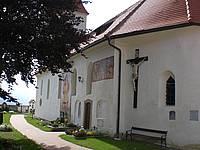
 Photo: Erlebnisregion Murtal
Filialkirche Feistritz
St. Marein/Feistritz, Styria
The two-nave church, surrounded by a walled cemetery, was built in 1445 and, after a redesign, was re-consecrated in 1515 by the Bishop of Trieste. Further alterations took place during the Gothic and Baroque periods. In 1972, murals from the 15th and 16th centuries were uncovered.The first church from 1070 goes back to a proprietary church of the nobleman Hartnid von Traisen. In 1445, Andreas Enstaler had the two-nave church built by the Admont master builder Niklas Velpacher.After a redesign, this magnificent church was consecrated in 1515 by the Bishop of Trieste. The striking double patronage - John the Baptist and John the Apostle and Evangelist - suggests a special significance of this church. The St. John's Church in Feistritz can probably only be seen as the original baptismal church of the Knittelfeld basin.The current nave represents a rectangular, flat-ceilinged room with stucco fields from around 1700. To the north, an extended annex adjoins, which also includes the current sacristy. The semicircular apse in the east features an early Gothic window and a late Gothic rib vault. The murals from the end of the 16th century, uncovered there in 1972, show, from north to south, Christ with Salome and her sons John and James, the stigmatization of St. Francis of Assisi, and St. Jerome. The altarpiece of the high altar, which is a Rococo work from the late 18th century, points to the two church patrons with their symbols. On the south wall of the nave is the statue of St. Nepomuk in front of a canopy curtain, a work by Balthasar Prandstätter from the late 18th century. Above the sacristy portal, which has a wooden door fitted with iron plates, is a crucified Christ from the 16th century. On the ground floor of the west tower, which is crowned with a pointed spire, is the open vestibule on three sides with a late Gothic church portal. The door is fitted with metal fittings featuring bird motifs and diamond patterns. The organ dates from 1886. Of the 3 bells, the oldest was cast in Graz in 1751, the other steel bells are from 1918 and 1919. Through the comprehensive renovation, beginning in 2003 until 2006, our church has gained even more as a sight. A surprise was the discovery of existing, but for centuries hidden, murals on the south and north walls of the church. Apostle figures from the second half of the 14th century as well as an Annunciation with Mary and the angel from the beginning of the 18th century came to light. The largely preserved and made visible scene of the triumphant Christ with numerous angels and saints, which can be admired on the north side, dates from 1704, as can be seen from the inscription on the upper edge.
Map & directions
Events nearby
Upcoming events within 10 km.



Experiences
Tours & activities in Steiermark
Guided tours, tickets and experiences in Steiermark — bookable via GetYourGuide.