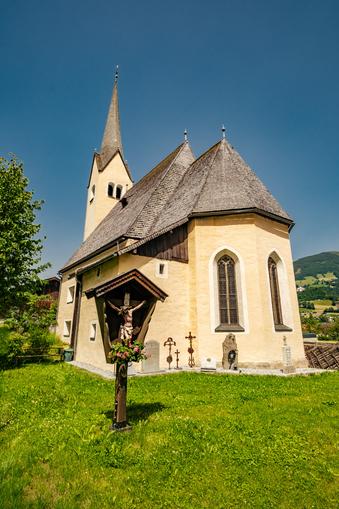
 Photo: Mittersill Plus GmbH (c) Wolfgang Spekner
Felberkirche
Mittersill, Salzburg
Felberkirche The Felberkirche, described by the well-known local historian Canon Lahnsteiner as the most interesting jewel of the Pinzgau, was built around 1250 in Romanesque style. The founders of the church were the noble-free Herren von Velben, who had also built their main church in St. Johann in Tirol and served as important officials (ministeriales of the archbishop and regional princes) in Salzburg for two centuries. After an expansion in the 15th century and the construction of the tower in 1522 (which can be seen clearly on the north wall of the church), the church today appears as a simple, late Gothic building. The steps leading into the church and the walkways paved with stones, found during excavations at a depth of 1.50 meters, testify to embankments caused by floods and debris in the Felben district. The interior of the church features an interesting star-rib vault with coat of arms shields at the intersections of the ribs. These include the coats of arms of the Archbishopric of Salzburg, the holders of the four hereditary or court offices (chamberlain, steward, cup-bearer, and marshal), as well as the most prominent official families of the Pfleggericht Mittersill. The patron saint of the church was chosen as St. Nicholas. He is considered the patron of all who travel dangerous roads. It is likely that packers, craftsmen, and harvest helpers crossing the Felber Tauern invoked St. Nicholas for intercession, protection, and safe return. In the 15th century, the veneration of the Holy 14 Holy Helpers began throughout the Alps, especially among common people. The Felberkirche was also equipped with wonderful Gothic statues of the Holy Helpers on the main altar. By the time the high altar was built in 1631, the great era of the Holy Helpers had already passed. Further depictions of the Holy Helpers can be found on the west gallery (around 1700) and as paintings from around 1780 in the presbytery. As a series of votive tablets shows, the Felberkirche was a popular Marian pilgrimage site in the 18th and 19th centuries. Mary was regarded as the patroness of the distressed and helper in all troubles. The Marian statue – dressed in precious garments until the 20th century – was given a place of honor in the center of the main altar. The images of the two side altars (family altar and St. Martin's altar) are by the Mittersill artist Petrus Schmid the Younger.
Opening hours & season
- 17.11.2023 – 31.12.2026daily07:00–20:00
Map & directions
Events nearby
Upcoming events within 10 km.


Experiences
Tours & activities in Salzburg
Guided tours, tickets and experiences in Salzburg — bookable via GetYourGuide.