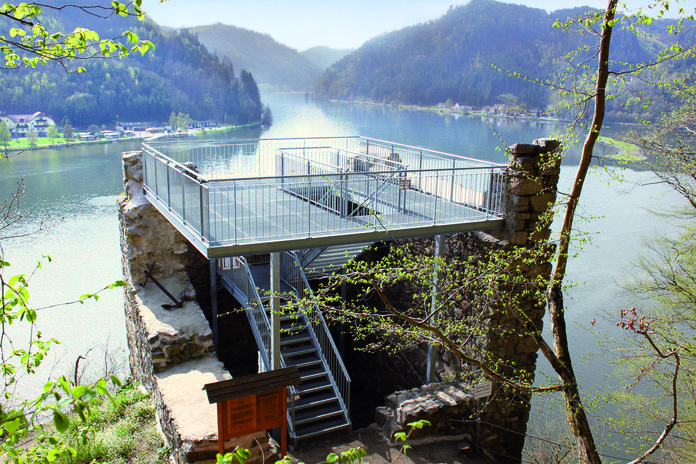
Donaublick Kettenturm
St. Martin i. Mühlkreis, Upper Austria
The Kettenturm, also popularly known as the Lauer- or Räuberturm, stands on a protruding granite rock approximately 25 m above the Danube's surface, on the steep rock face below Neuhaus Castle. The originally 18 m high Kettenturm has a base area of 8 x 8 m. The granite masonry made of quarry stone has a thickness of 1.50 to 1.70 m. The second upper floor (approx. 1.10 m thick) has almost completely collapsed. In 1371, the noble family of Schaunberger received the right from the sovereign to collect a toll on the Danube near Neuhaus. Ships were prevented from continuing their journey by a chain stretched across the Danube. After paying a "toll", the journey could be continued. Arbitrary toll fees soon led to complaints from merchants and trading ships from Passau against the Schaunberger family. In 1381, a feud broke out between the sovereign and the Schaunberger family. Finally, an arbitration ruling ended the dispute and prohibited the collection of the toll. Remains of fired clay bricks bear witness to the preservation work under Albrecht von Sprinzenstein around 1583. During the Upper Austrian Peasant War in 1626, the Danube near Neuhaus was again blocked with a chain to prevent the supply of soldiers, weapons, and provisions by ship to the city of Linz, which was besieged by the peasants. During the Napoleonic Wars at the beginning of the 19th century, the Danube was blocked here for the last time. Emperor Napoleon had the chain brought to Paris as a "souvenir". Today, according to the French Ministry of Defense, the chain is located in the Army Museum in Paris. It is 180 m long and weighs 3580 kg.
Map & directions
Events nearby
Upcoming events within 10 km.


Experiences
Tours & activities in Oberösterreich
Guided tours, tickets and experiences in Oberösterreich — bookable via GetYourGuide.