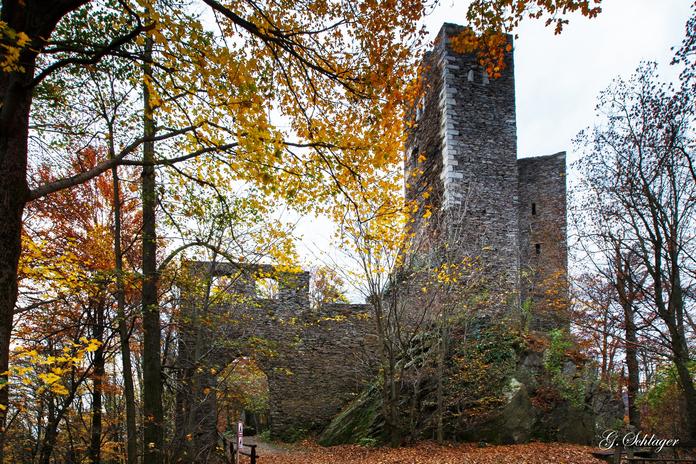
 Photo: Schlager Gerhard
Burgruine Stauf
Haibach o.d. Donau, Upper Austria
The History: In 1125, Wernhard de Stove is first mentioned as the owner of Stauf Castle, who from 1146 called himself Heinrich de Julbach with his son, and from 1161 Wernhart von Schaunberg. In 1386, Stauf was occupied by Duke Albrecht and subsequently inhabited by caretakers. With the death of Wolfgang II in 1559, Stauf fell to Wolfgang von Liechtenstein and Nikolsburg during the inheritance division. In 1593, Helmhard Jörger then acquired the dominion of Stauf. He, along with the Protestant estates, offered open resistance against Emperor Ferdinand II, who confiscated the Jörger properties and handed them over to the Imperial Prince Karl von Harrach in 1622. Since this time, Stauf has been in the possession of the Harrach family.The medieval complex consists of a keep, palas, and outer bailey, of which only the main walls made of rubble and quarry stones remain. The 21.67 m high keep, accessible from the inner castle courtyard, has an irregular hexagonal shape on the outside but is square on the inside. The lowest floors have pointed barrel vaults, the tower edges on the outside are reinforced with ashlar blocks, and the window slits have Gothic stone frames.The Stauf castle ruin, with its still climbable tower (viewing platform), has become a well-known and popular excursion destination due to the rarely beautiful panoramic view that presents itself to visitors in clear weather.By car:Westautobahn exit Linz or Wels towards Eferding, continue on the B130 towards PassauBy train:Linz or Wels main station, continue by post bus towards Eferding - Haibach orPassau main station, continue by post bus towards LinzThe Location: Altitude: 531 m above sea level in the "Naturwunda" (nature wonder) municipality of Haibach ob der Donau - accessible via hiking trails or from the parking lot near the B 130.
Opening hours & season
- 01.05.2026 – 30.09.2026daily07:00–20:00
- 31.10.2026 – 30.04.2027daily08:00–18:00
Map & directions
Events nearby
Upcoming events within 10 km.

Experiences
Tours & activities in Oberösterreich
Guided tours, tickets and experiences in Oberösterreich — bookable via GetYourGuide.