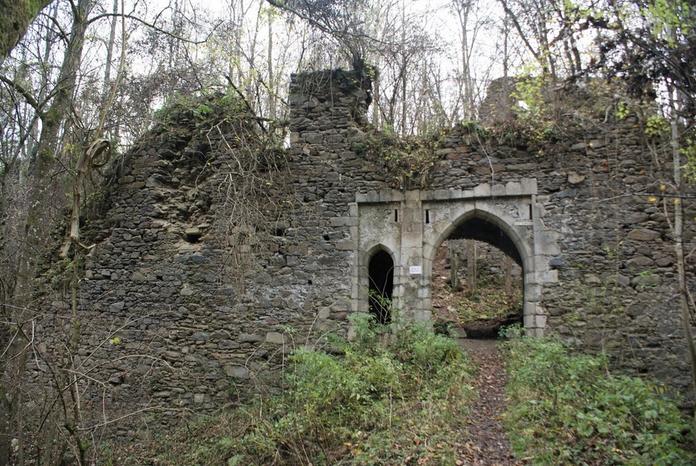
Burgruine Falkenstein
Hofkirchen, Upper Austria
From the 13th century onwards, the cultivation and thus the settlement of the Upper Mühlviertel was promoted from this area. The well-known Schlägl/Böhmerwald Abbey was also founded by the Falkensteiners. Today, Falkenstein is an increasingly decaying ruin. The remains of the walls give an idea of how large and mighty the castle was centuries ago. The massive 15th-century water tower was saved from decay by an initiative.The founding legend of FalkensteinMany hundreds of years ago, the powerful noble family of the Counts of Peilstein lived in the Upper Mühlviertel. The Count, about whom the legend tells, was a passionate hunter. He owned several valuable hunting falcons. The noble pages Rudger and Ralf were entrusted with their care. They were good friends. One day, Rudger unluckily lost the Count's favorite falcon. In boundless anger, the Count threatened to have the boy dragged to death if the falcon was not brought back within three days. Since Ralf did not abandon his friend, both of them roamed almost the entire hunting ground of the Count. They did not find the falcon. Discouraged and desperate, Rudger gave up the search on the evening of the last day and returned to his lord's castle. Ralf, however, continued the search. While Rudger spent his last night in the castle dungeon, Ralf roamed alone through the forest in the moonlit night. He paid no attention to the thorns that tore his clothes, nor was he frightened by the howling of the predatory wolves. Whistling softly and thus luring the falcon, he pressed on.In the valley of the Rannabach, he climbed a rock to get a better view. There he saw the falcon close in front of him. Ralf lured it with the usual call. The lost bird willingly allowed itself to be caught. Ralf rejoiced - now he could save his dear friend. He quickly set off on his way home. Dawn was already breaking when he finally saw his lord's castle before him. The sun rose as he approached the castle gate. Breathless and exhausted, he rushed into the castle courtyard - and saw his friend. He stood bound and was about to be tied to the tail of a wild black horse. Ralf cried out. Then the Count saw him. He saw the falcon, and immediately his anger was appeased. Rudger was freed from his bonds. Weeping with joy, the friends embraced. The Count had Ralf show him the place where the falcon had been found. The area pleased the Peilsteiner very much. Therefore, he had a castle built on the rock and named it Falkenstein. His family was henceforth called "Falkensteiner" after the castle. In the 13th century, the Falkensteiners began their clearing and settlement activities towards the Böhmerwald from the developed area around Falkenstein. Thus, Calhoch II of Falkenstein founded the Schlägl Monastery on the Große Mühl at the foot of the Böhmerwald on July 29, 1218.Rescue of the Falkenstein Castle RuinFor three years, great efforts have been underway in Hofkirchen i. M. to prevent the complete collapse of the internationally known Falkenstein Castle Ruin.Over 40 relevant interested parties and experts enthusiastically volunteered to help with the rescue operation for Falkenstein Castle. The range of volunteer helpers extended from academic art experts and technicians to artists, students, teachers, and trained craftsmen.Since then, the individual ruin rescuers have formed a homogeneous working team that enjoys working together amidst the old walls. Overall, great progress has been made in preserving the unique old walls. In best agreement with the Federal Monuments Office, work is being done step by step to achieve the common goal of preventing the further decay of the up to 800-year-old castle complex. This year, the volunteer helpers were active on site for a total of 10 working weekends until mid-October. In addition to the four fixed priority weekends, there were also individual work assignments by several activists on six other weekends.Falkenstein Castle is the root of the settlement history of the Mühlviertel, including adjacent Bavarian and Bohemian regionsThe Falkenstein ruin was donated by the Bishops of Passau. The purpose was the clearing of the surrounding region, including parts of Bavaria and Bohemia. Zawisch von Falkenstein was the most famous scion of the family and rose to become the successor of Bohemian King Ottokar in the late High Middle Ages. He was subsequently beheaded in Hluboka and buried in the Bohemian monastery of Hohenfurt. The famous Zawisch Cross is kept in Hohenfurt Abbey in Bohemia and forms the centerpiece of the bilateral Upper Austria/Bohemia regional exhibition in 2013. Calhoch von Falkenstein founded Schlägl Abbey 800 years ago, which can rightly be described as the cultural center of the Rohrbach district.After a rather quiet slumber during the past 15 years, the Falkenstein castle complex is experiencing a large influx again due to the regular preservation activities. Older people, families, tourists, and school classes are equally attracted by the ancient walls and are pleased about the tireless volunteer work to prevent the final decay of this unique monument jewel and window into the late Middle Ages and further centuries.A ruin approx. 2 kilometers outside the Hofkirchen i.M. municipal area.
Map & directions
Events nearby
Upcoming events within 10 km.

Experiences
Tours & activities in Oberösterreich
Guided tours, tickets and experiences in Oberösterreich — bookable via GetYourGuide.