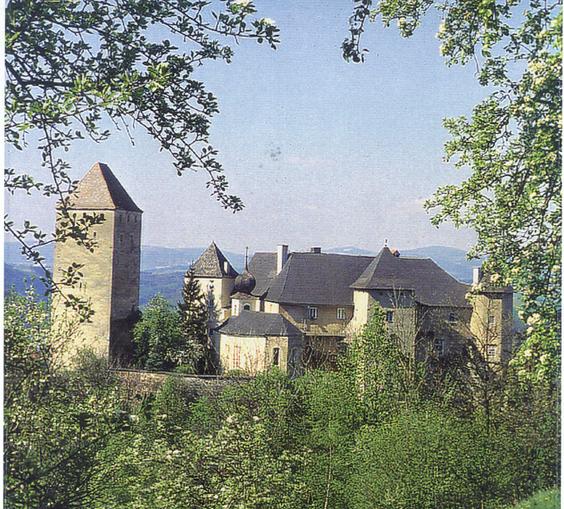
Burg Vichtenstein
Vichtenstein, Upper Austria
Vichtenstein Castle - Of Feud and the Bishop's Victory The romantic Vichtenstein Castle is located in the center of Vichtenstein, just a few meters off the Donausteig. It was probably founded in the 11th century by one of the Counts of Formbach. After the extinction of this lineage in 1145, the castle passed to the Hallgrafen of Wasserburg. In 1217, a turning point began that would throw the region into turmoil for years! Konrad, Count of Wasserburg and Vichtenstein, wanted to undertake a crusade to the Holy Land and borrowed money from the Prince-Bishop of Passau for it. As collateral, he gave Vichtenstein Castle with numerous possessions. Before his departure, Konrad married and transferred the castle to his wife. However, the Diocese of Passau considered the castle their property and deemed this transfer illegal. Thus began an 8-year feud between Konrad and the diocese. He harmed Passau wherever he could: he destroyed Passau's property, attacked Passau merchants, blocked the Danube, ... His strategic "masterpiece": Since Passau's prosperity was based on the salt trade, Konrad diverted Salzburg salt past Passau! He used his salt trade privileges as Hallgraf and had the salt transported down the Inn landed in Schärding. Then it was transported overland via Münzkirchen, Vichtenstein, and Kasten to Obernzell, from where it found its usual way to Bohemia. This not only harmed Passau but also earned him a very good living! For his actions, Konrad was eventually excommunicated multiple times (!) and later even outlawed. Ultimately, however, he had to submit. Thus, in 1227, Vichtenstein passed into the possession of the Diocese of Passau for the next 550 years. Soon after, the newly founded Engelszell Monastery was supported by being exempted from the Vichtenstein toll and also received all storm-damaged trees from the Vichtenstein dominion in 1299. In later years, the castle was a popular hunting lodge for the Passau bishops. The Jagabild Chapel on the ridge of the Haugstein has wondrous tales to tell of this hunting era! More on this under "Jagabild Chapel - a wonderful gem!". In 1803, the rule of the Diocese of Passau ended due to secularization, and Vichtenstein Castle fell to the Austrian state. From 1860, a period of changing private ownership began. Today, the castle is owned and inhabited by the Schulz-Wulkow family. The castle cannot be visited! (Source: Schulz-Wulkow, K. (2012). Vichtenstein im Sauwald) By the way: Castle hills were formerly kept free of forest for military reasons. This also helped the Pöstlingberg in Linz gain popularity as a panoramic mountain after the abandonment of the Maximilianian fortress. Today, the Pöstlingberg is the landmark of Linz and a must for every Donausteig hiker! By public bus: Linz – Engelhartszell – Kasten – Vichtenstein (Postbus); Passau – Vichtenstein By train: Passau or Schärding By ship: Kasten ship landing stage: Wurm & Köck shipping company, D-94032 Passau, Höllgasse, Tel. +49 851 929292 By car: From Vienna/Linz: Linz – Eferding – Engelhartszell – Kasten – Vichtenstein (70 km) on the Nibelungen Bundesstraße B 130 From Munich/Passau: Autobahn exit Passau-Mitte – direction Engelhartszell B 130 – Kasten – Vichtenstein (18 km). From Salzburg: Braunau – Schärding – Vichtenstein on the Sauwald-Bundesstraße B 136. (Schärding – Vichtenstein: 20 km)
Map & directions
Anzeige
Events nearby
Upcoming events within 10 km.
Experiences
Tours & activities in Oberösterreich
Guided tours, tickets and experiences in Oberösterreich — bookable via GetYourGuide.