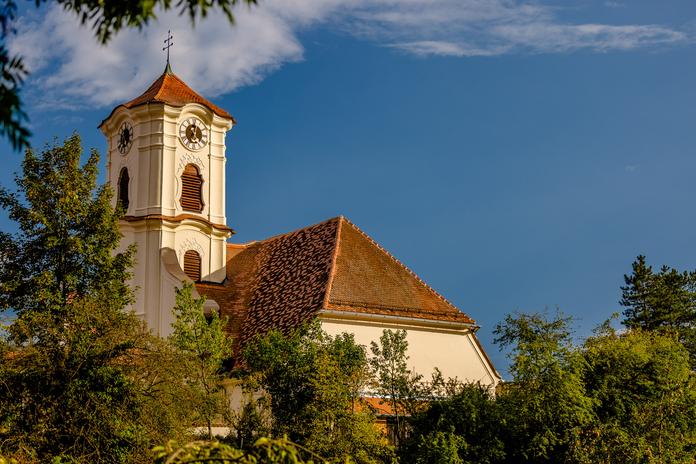
 Photo: Stadtmarketing Fürstenfeld
Augustiner Eremiten Kirche
Fürstenfeld, Styria
The monastery, demolished in 1956, consisted of an inner courtyard with a cloister, surrounded by three wings. In 1367, Archbishop Ortholph von Aponien consecrated the monastery. In 1480, troops of the Hungarian King Matthias Corvinus completely plundered it, monastery inmates were captured, and Brother Heinrich von Rattenburg was strangled (memorial plaque in the passageway). In 1503 and 1685, fires caused severe damage, and in 1683, an explosion of the nearby powder tower. In 1685, the church was rebuilt under the direction of master builder Hueber. In 1811, the monastery was dissolved. In 1945, the church was damaged again. In 1978 (the city's 800th anniversary) and in the following years, the church was fundamentally renovated, and Gothic frescoes were uncovered, depicting apostles and prophets in the circular medallion of the altar area. Large-format frescoes of kings and prophets are visible at the bases of the cross-rib vaults. Further frescoes are located on the south wall, one of which is likely a depiction of Duke Rudolf IV, while others depict a Turkish building and a Turkish head with a turban. The frescoes were created by Johannes Aquila, which is also commemorated by a plaque at the church entrance. Another memorial plaque in the passageway commemorates P. Johannes Clobucciarich (*1545, +1605). He worked in the monastery from 1575 – 1605, from 1585 as prior. P. Clobucciarich was an important cartographer and created the first survey of Inner Austria. He died in 1605 while fleeing from the Hungarians. To learn more about the former monastery church, we recommend taking a fortress tour. https://www.festungsweg.at/ The Fürstenfeld Tourist Information is happy to answer any further questions. Fürstenfeld Tourist Information, Hautpstraße 2a, Tel.: +43 3382/55100-81
Opening hours & season
- 01.01.2026 – 31.12.2026daily08:00–18:00
Map & directions
Events nearby
Upcoming events within 10 km.



Experiences
Tours & activities in Steiermark
Guided tours, tickets and experiences in Steiermark — bookable via GetYourGuide.